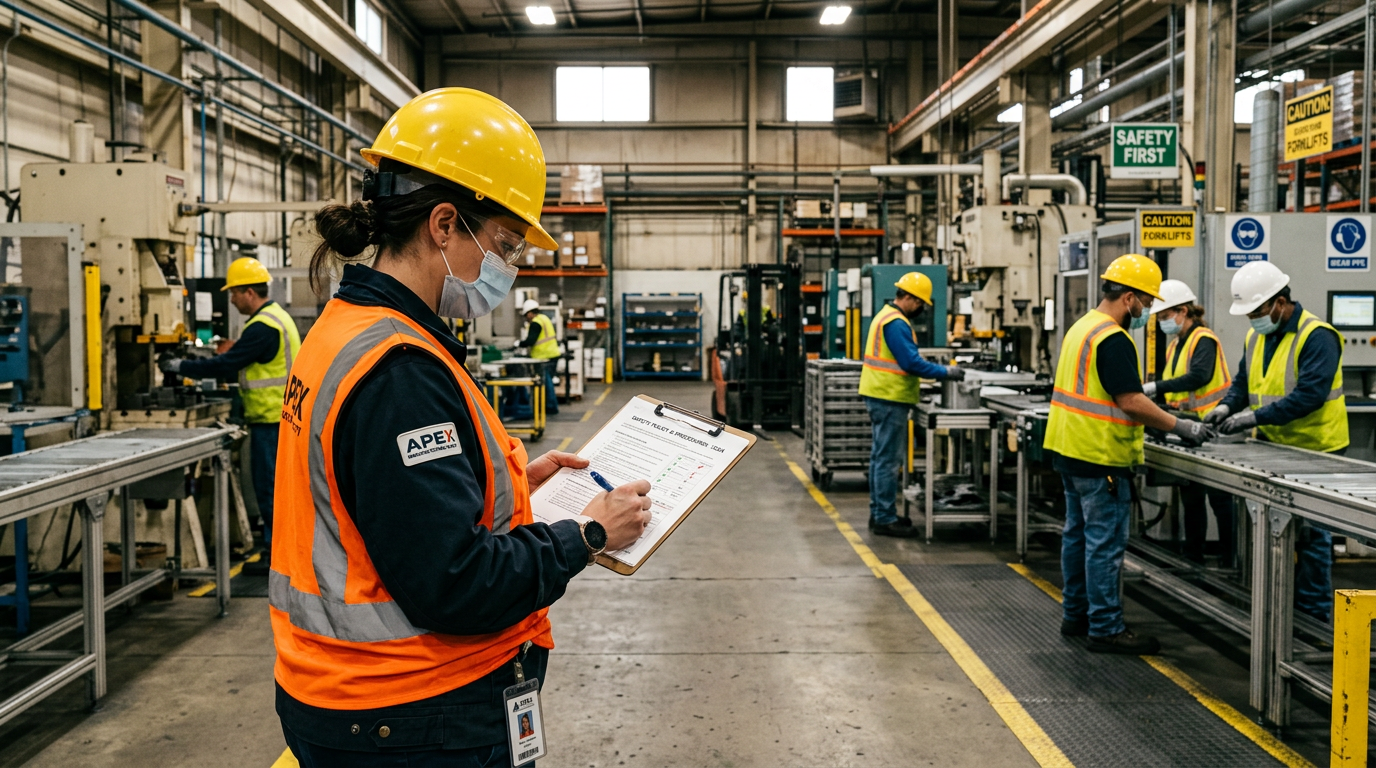
The Safety Policy That Exists on Paper and Nowhere Else
Every manufacturing facility and construction site has a PPE policy. It is laminated, posted near the entrance to the production floor or site gate, and covered during onboarding. New workers sign a form confirming they understood it.
That form is filed somewhere. The policy is updated annually. The safety officer has records of every briefing session going back three years.
And on Thursday at 3pm, when the safety supervisor was two floors up in a budget review meeting, no one knows what was actually happening on the floor.
That is the gap. Not negligence. Not malice. A structural flaw in how most safety systems are designed.
Most safety programs are built to produce compliance documentation, not to produce compliance. The audit trail -- briefing records, policy sign-offs, periodic inspection logs -- is built to satisfy a regulator who asks "do you have a safety program?" It is not built to answer the question "was your safety program being followed at 14:47 on Camera 7?"
Those are different questions. And for most industrial facilities operating today, only the first one has an answer.
Here is what a typical scenario looks like. A mid-sized electronics assembly plant in Penang. Roughly 300 workers across two shifts. A published PPE requirement: safety glasses and cut-resistant gloves for anyone within three meters of the stamping line.
The policy exists. The briefings happened. The forms are signed.
What the safety manager could not tell you with any confidence is how often that requirement was actually followed during unobserved hours -- the first 20 minutes of a shift before the supervisor walked the floor, the stretch after lunch when everyone was still settling back in, or the 40-minute window when the team lead was pulled away to deal with a material delivery.
He could tell you there had been no reported incidents. He could not tell you there had been no violations.
Those are also different things.
The friction in this system is not human. It is architectural. A human safety officer can only be in one place at a time. A physical patrol covers a zone at intervals -- typically every 60 to 90 minutes in a well-run facility. Everything that happens between patrols is unobserved. The documentation architecture was built around that constraint and accepted it as a given.
AI safety monitoring for manufacturing and construction sites changes that constraint. A system processing live camera feeds does not patrol on a schedule. It watches continuously. It does not have a meeting at 2pm. It does not cover one zone at a time. With universal camera compatibility, it integrates with the CCTV infrastructure already installed on the floor -- no new hardware, no rip-and-replace project.
AI access control on manufacturing floors and PPE detection on construction sites both depend on this same principle: continuous detection, not periodic inspection. The result is not better documentation. It is actual enforcement.
The turning point for facilities that implement AI safety monitoring is not the first alert. It is the first week of data.
That data -- PPE compliance rates by shift, by zone, by hour of day -- is almost always surprising. Not because workers are negligent, but because the policy was never enforced continuously enough to become a real habit. The compliance rate looks different at 6am, at 2pm, and at 9pm. It looks different on Monday and on Friday. It looks different when the supervisor is present and when she is not.
None of that variation was visible before. The documentation showed a clean record. The data shows the actual pattern.
The lesson is not that your workers cannot be trusted. The lesson is that continuous AI safety monitoring on construction sites and factory floors creates the conditions for real compliance -- the kind that becomes habit, not the kind that appears on a form.
The question worth asking is not "do we have a safety policy?" Almost every facility does. The question is: "do we know whether our safety policy was followed at 14:47 on Camera 7?"
If the honest answer is no, the architecture needs to change -- not the policy.
HyperQ AI Safety is built for exactly that problem. Learn more at hypernology.net.