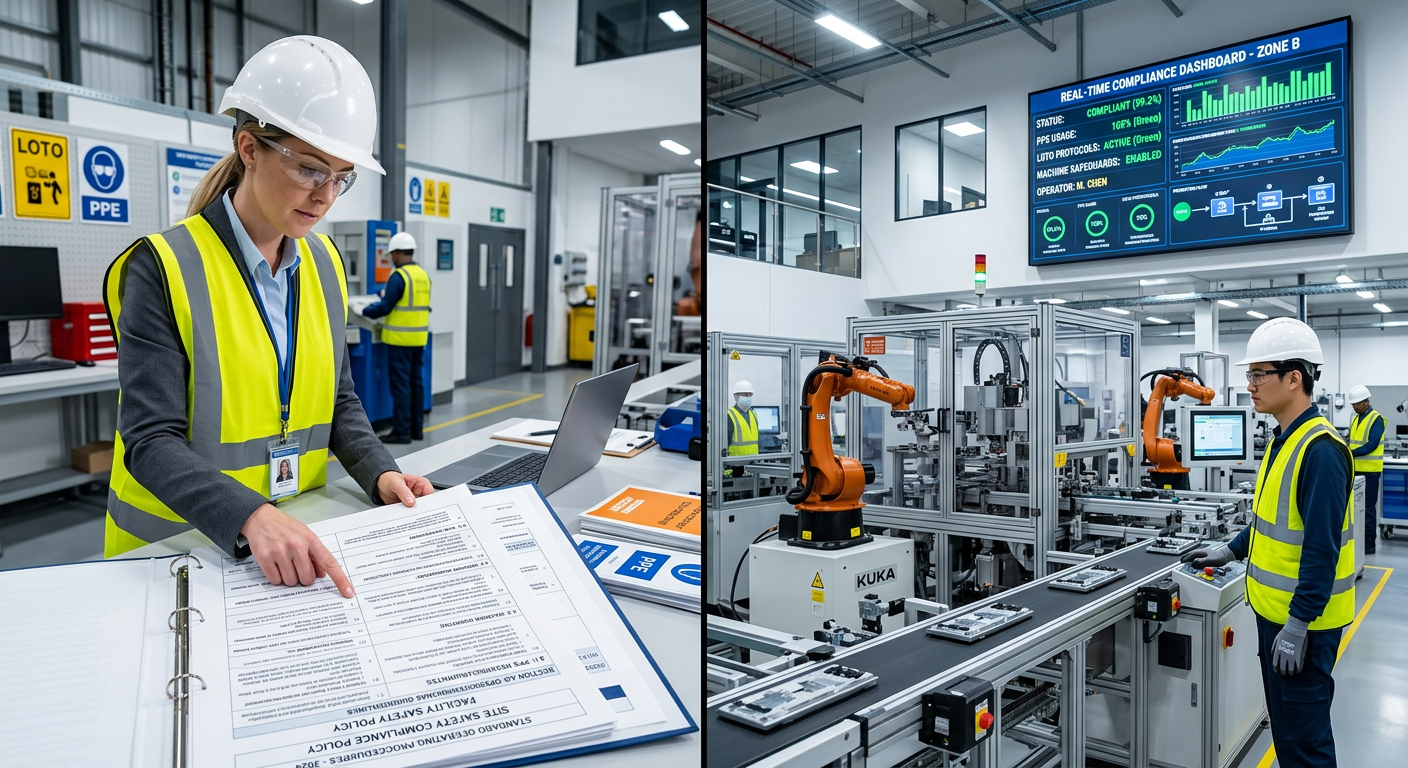
The Gap Between Having a Policy and Having Evidence the Policy Was Enforced
When a regulator arrives at your facility, they do not open your safety policy document first.
They ask for evidence. Timestamps. Incident logs. Monitoring records. Alerts that were triggered and responses that were logged. They want to know what your systems actually captured -- not what your policy says should have happened.
Most APAC manufacturers have the policy. Very few have the evidence. And the ROI of AI safety monitoring in manufacturing comes precisely from closing that gap before an incident makes it expensive.
Under Singapore's Workplace Safety and Health (WSH) Act, a written safety management system is not a defense against liability -- it is a baseline requirement. The defense is demonstrable enforcement: records showing that your safety program was operational, that violations were detected, that responses were logged, and that corrective action followed. The same framework applies under Malaysia's DOSH guidelines, where the burden of proof in a workplace incident investigation falls on the employer to show what monitoring was in place and what it captured.
A policy document satisfies neither standard. It tells the regulator that you knew what should happen. It does not tell them what actually happened at 09:23 on the morning of the incident.
This gap -- between having a policy and having evidence the policy was enforced -- has a name: compliance liability. It is the exposure that exists when your documentation architecture produces records of intent rather than records of action.
Consider what the compliance evidence gap looks like in practice. A factory floor in Johor Bahru. Three production lines. A clear PPE mandate in writing. Regular safety briefings. A trained and qualified safety officer on roster.
An incident occurs. A worker is injured near Line 2. The investigation begins.
What the safety team can provide: a copy of the policy, a list of workers who attended the last safety briefing, a patrol schedule showing the safety officer's planned rounds.
What the investigation actually requires: camera timestamps showing who was in the hazard zone, PPE compliance logs for that zone during the 30 minutes before the incident, an alert record showing whether any violation was flagged and what response was triggered.
The first set of documents demonstrates that a safety program existed. The second set demonstrates that it was working. In a regulatory investigation or a civil liability proceeding, only the second set is a defense.
The ROI of AI worker safety programs is often framed around incident reduction. That is real, but it is only part of the picture. The more direct financial calculation is liability exposure.
A single workplace incident that proceeds to regulatory enforcement or civil litigation -- without a defensible monitoring record -- can carry penalties, legal costs, and reputational damage that dwarf the cost of any monitoring system. In Singapore and Malaysia, facilities that cannot produce timestamped monitoring evidence face significantly worse outcomes in both regulatory and civil proceedings.
The AI worker safety ROI calculation is not just "fewer incidents times cost per incident." It is "what is the value of a defensible compliance record when an incident does occur?" For most manufacturers, that number is not difficult to estimate.
What AI-based PPE monitoring produces -- by design -- is that defensible record.
A system like HyperQ AI Safety processes live camera feeds continuously, logging compliance events with timestamps, zone identifiers, and incident classifications. Every alert is recorded. Every response is traceable. The output is not a report that someone assembled after the fact. It is a live evidence record: what was monitored, what was detected, and when.
With universal camera compatibility, this integrates with existing CCTV infrastructure rather than requiring a new hardware deployment. The evidence layer builds on what is already installed on the floor.
The output is not just operational visibility. It is a defensible compliance record -- the kind that holds up when a regulator asks what your monitoring system actually captured at 09:23 on the morning of the incident.
In both Singapore and Malaysia, and increasingly across the broader APAC manufacturing sector, the regulatory standard is moving from "do you have a safety policy" to "can you demonstrate your safety program was operational."
Facilities that have built their compliance programs around documentation alone are carrying compliance liability. They have satisfied the prerequisite. They have not built the defense.
The architecture change required is not expensive or disruptive. It is a shift from systems that record intent to systems that record action -- from compliance documentation to compliance evidence.
If your current safety program can tell a regulator what your policy says but not what your cameras captured at 09:23, the gap is worth closing before an incident makes it visible.
HyperQ AI Safety is built to produce compliance evidence, not compliance paperwork. Visit hypernology.net to learn more.