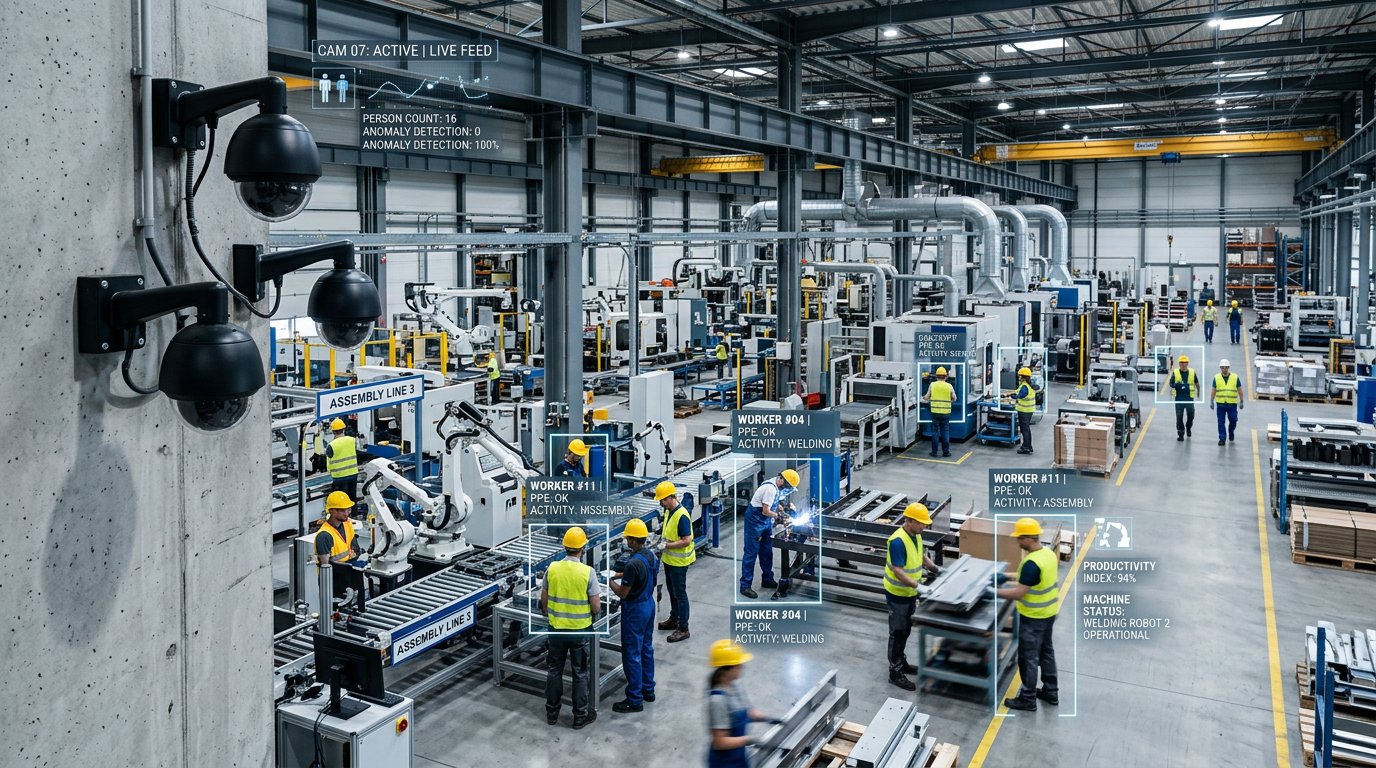
The Comparison Is Not Fair. That Is the Point.
Your safety officer cannot watch 200 workers simultaneously. A worker zone monitoring AI system does not need to sleep, take lunch, or attend the 2pm all-hands.
The comparison is not fair. That is exactly why it needs to be made.
Most industrial environments treat manual safety patrols as the standard. A qualified safety officer walks the floor on a schedule, checks for PPE compliance, flags violations, and logs observations. In a well-run facility, that patrol happens roughly every 60 to 90 minutes per zone.
That is considered good practice. In many jurisdictions, it meets the regulatory minimum. Safety managers have optimized around this model for decades -- better patrol scheduling, clearer checklists, more consistent logging.
The fundamental constraint has never changed. Between patrols, no one is watching. Whatever happens in that 60 to 90 minute window is unobserved. The safety architecture accepts this gap as an inherent feature of human-based monitoring and builds the rest of the system around it.
The gap is not a resource problem. It is an architecture problem.
Here is where most analysis of AI safety monitoring goes wrong. It frames AI as a replacement for the safety officer -- a cost-reduction measure, a headcount justification. That framing misses the point.
Manual safety patrols and worker zone monitoring AI are not doing the same job at different price points. They are doing structurally different things. A safety officer conducts periodic observation and brings judgment to complex situations. An AI monitoring system processes live camera feeds continuously, detects specific conditions -- PPE presence or absence, zone entry events, equipment proximity -- and logs every instance with a timestamp.
One is intermittent and contextual. The other is continuous and documented. Comparing them as substitutes misunderstands what each is actually capable of.
The correct question is not "can AI replace my safety officer?" The correct question is "what does my current safety architecture leave unobserved, and what would it take to close that gap?"
The coverage gap in manual monitoring is not a matter of effort or competence. It is a structural feature of human presence. A person can only be in one place. A person needs to rest, handle other responsibilities, and respond to whatever the shift demands.
A worker zone monitoring AI processing live CCTV feeds does not have those constraints. It detects a PPE violation in under three seconds. It triggers an alert immediately. It logs the incident with a timestamp and a camera reference. That capability operates across every camera in the system simultaneously, across every shift, without degradation.
The coverage is not better than a human patrol by degree. It is better by category. A patrol that covers a zone every 90 minutes and a system that monitors every second are not on the same scale. The difference is architectural.
Why does this matter enough to state plainly?
Because industrial facilities that are still benchmarking AI safety monitoring against their current manual patrol frequency are using the wrong frame. The benchmark is not "how often does a person walk the floor?" The benchmark is "what is the actual risk profile of unmonitored intervals, and is that risk acceptable?"
When you ask that question, the 60 to 90 minute patrol interval looks different. The unobserved window -- which seemed like an acceptable constraint under the old model -- starts to look like a design decision that has never been properly examined.
The practical implication is straightforward. AI worker zone monitoring is not here to replace the safety judgment your team brings to complex situations. It is here to close the gap between patrols -- to ensure that the enforcement layer of your safety program is not intermittent.
HyperQ AI Safety integrates with existing CCTV infrastructure through universal camera compatibility. The monitoring layer builds on what is already installed. The gap between patrols closes. The evidence record is continuous.
If your current safety architecture depends on humans being present to produce compliance, the architecture is the problem. Learn more at hypernology.net.