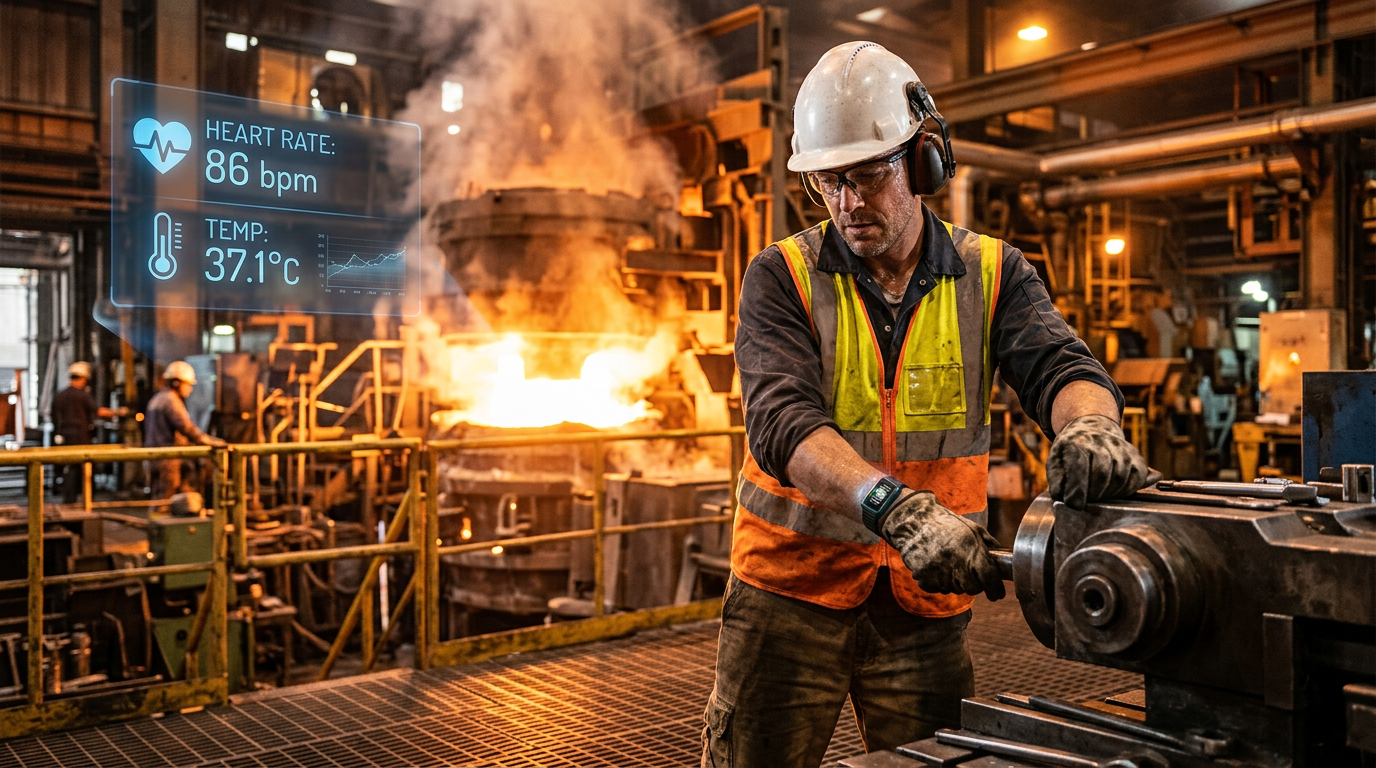
The hidden danger on the production floor
For EHS managers in manufacturing, heat stress is one of the most underestimated workplace hazards. Unlike missing helmets or unattended machinery, heat stress develops silently inside the worker's body. By the time symptoms become obvious, the window for safe intervention has often closed.
The question facing industrial safety teams today is not whether heat stress monitoring matters. The question is how to deploy continuous, real-time physiological surveillance that complements existing safety protocols. AI-powered wearables provide the answer.
Understanding the biological progression: From stress to emergency
Heat stress follows a predictable but rapid physiological cascade.
Stage 1: Heat stress (compensatory phase)
- Core temperature rises to 38-39 degrees C
- Heart rate increases 10-20 beats per minute above baseline
- Profuse sweating as the body attempts thermoregulation
- Worker remains functional but cognitive performance begins declining
Stage 2: Heat exhaustion (decompensation begins)
- Core temperature reaches 39-40 degrees C
- Heart rate exceeds safe working limits, typically above 140 bpm for sustained periods
- Blood pressure fluctuates as cardiovascular strain intensifies
- Dizziness, nausea, and confusion emerge
- Medical intervention required--recovery takes hours to days
Stage 3: Heat stroke (medical emergency)
- Core temperature exceeds 40 degrees C
- Thermoregulatory system fails completely
- Altered mental status, seizures, loss of consciousness
- Permanent organ damage or death without immediate treatment
This progression can occur within 15-45 minutes under high-heat manufacturing conditions. Traditional workplace safety checks--scheduled breaks, supervisor walkarounds, self-reporting--cannot respond fast enough.
How context-aware wearables change the standard of care
Modern AI wearables designed for industrial environments transform heat stress monitoring by tracking multiple physiological parameters simultaneously. Hypernology's Smartband integrates with HyperQ AI Safety to monitor workers in real time.
The four biomarkers that matter
1. Heart rate variability and sustained elevation The Smartband monitors not just heart rate but pattern changes. When a worker's heart rate jumps from 80 to 130 bpm and stays elevated, that signals cardiovascular strain before the worker feels distressed.
2. Blood oxygen saturation (SpO2) Heat stress impairs oxygen delivery to tissues. SpO2 drops below 95% indicate the body is struggling to maintain normal function--a leading indicator often missed until collapse.
3. Continuous body temperature Unlike periodic checks with infrared thermometers, wearables track body temperature every second. Sustained readings above 37 degrees C at the wrist correlate strongly with dangerous core temperature elevation.
4. Blood pressure monitoring Integrated sensors detect blood pressure fluctuations that indicate cardiovascular stress. Orthostatic changes--pressure drops when standing--are early heat exhaustion markers.
Pattern recognition beyond human capability
What separates context-aware wearables from simple fitness trackers is contextual intelligence. The system learns each worker's baseline physiological profile during normal operations. Machine learning algorithms then identify deviations that signal heat stress--not just absolute threshold breaches.
Example: A 45-year-old machine operator's heart rate at 120 bpm might be normal during equipment loading. But if that same 120 bpm occurs while standing still during a quality inspection, the AI flags it as an anomaly requiring investigation.
The alert system: Two-tier intervention
When the system detects danger, intervention happens at two levels simultaneously.
Level 1: Worker-directed alert The Smartband vibrates on the worker's wrist with escalating intensity patterns. This immediate tactile feedback--distinct from ambient noise and visual distractions on the factory floor--prompts self-protective action: moving to shade, hydrating, slowing work pace.
Level 2: Supervisor dashboard notification The safety supervisor's real-time dashboard displays the alert with the worker's location, current vital signs, and deviation from baseline. The supervisor can immediately deploy assistance, reassign tasks, or initiate cooling protocols.
This dual-alert system addresses a key limitation of traditional safety programs. Workers under heat stress often experience impaired judgment and may not recognize their own deteriorating condition. The system does not rely solely on self-reporting.
Regulatory compliance and evidence documentation
For manufacturing facilities subject to South Korea's Serious Accident Punishment Act or pursuing ISO 45001 certification, heat stress monitoring provides tangible documentation advantages.
Audit-ready evidence trail Every physiological data point, alert, and intervention response is timestamped and stored. When regulators or certifying bodies ask what measures were in place to prevent foreseeable workplace injuries, the data speaks for itself.
Proactive risk mitigation documentation ISO 45001 requires demonstrated commitment to eliminating hazards and reducing OH&S risks. Continuous physiological monitoring shows systematic risk control--not reactive incident response.
Integration with existing safety management systems Heat stress data integrates with broader EHS platforms. Cross-reference heat alerts with production schedules, ambient temperature logs, and workstation assignments to identify systemic risk factors and deploy engineering controls.
Cameras see compliance, wearables see physiology
AI wearables work alongside vision-based safety systems. Camera-based systems excel at detecting visible safety violations: missing helmets, improper glove use, restricted area entry.
But cameras cannot see what is happening inside the worker's body. You cannot visually detect elevated heart rate, dropping blood oxygen, or cardiovascular strain. This is where wearables become necessary.
HyperQ AI Safety integrates both technologies. Vision AI handles PPE compliance and hazard detection. Wearable AI monitors physiological stress and health indicators. The context-aware VLM (Vision-Language Model) distinguishes real threats from normal operations--HyperQ AI Safety distinguishes between a welding flame and an actual fire.
The system deploys in approximately 1 hour using existing CCTV infrastructure. Zero-shot extensibility via natural language prompts allows safety teams to add new hazard scenarios without retraining the model.
Deployment for EHS managers: Key considerations
Start with high-risk zones Deploy wearables first in foundries, welding areas, hot-press operations, and outdoor summer assignments where heat exposure is documented.
Baseline establishment period Allow 2-3 weeks for AI systems to learn individual worker profiles before activating automated alerts. This reduces false positives and builds worker trust.
Integration with break policies Align heat stress alerts with existing heat illness prevention plans. When alerts trigger, make sure workers have immediate access to cooling stations and hydration.
Privacy and data governance Establish clear policies on health data access, retention, and use. Workers must understand that physiological data serves safety--not productivity monitoring or disciplinary actions.
Prevention, not response
Heat stress injuries are entirely preventable with timely intervention. The challenge has always been detection before symptoms become severe. AI wearables solve this by making the invisible visible--transforming internal physiological changes into actionable safety intelligence.
The goal of modern industrial safety technology is incident prevention. Every heat stroke prevented, every worker sent to cooling before exhaustion sets in, represents the technology fulfilling its core purpose.
For manufacturing EHS professionals facing increasing regulatory scrutiny, rising summer temperatures, and aging workforce demographics, heat stress monitoring through AI wearables has become the standard of care.
About Hypernology: We develop AI-powered safety solutions for industrial environments, including vision-based PPE detection, physiological monitoring wearables, and integrated safety management platforms. HyperQ AI Safety deploys in approximately 1 hour using existing CCTV infrastructure--providing real-time worker protection through the combination of context-aware computer vision and wearable sensor technology.