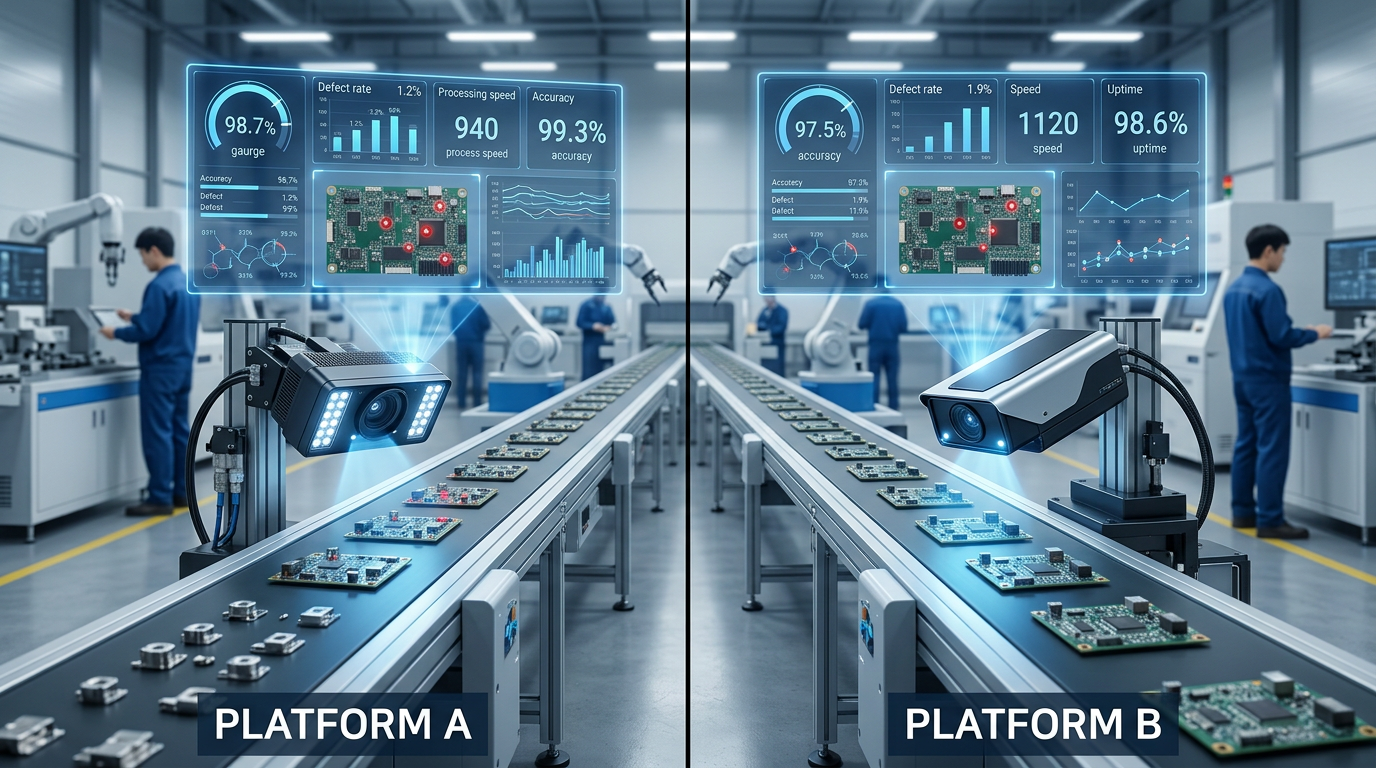
When Korean electronics and automotive manufacturers evaluate AI vision solutions, two homegrown platforms consistently appear: Neurocle and Hypernology. Both offer deep learning-based defect detection that outperforms rule-based vision vendors. For production-critical deployments where vision and safety integrate, the differences matter.
If you manage quality operations at Samsung SDI, LG Electronics, or evaluate Korean AI vision providers, here's what separates these platforms--and why hundreds of APAC manufacturers chose HyperQ for production lines.
The core difference: vision + safety vs. vision only
The main distinction between Hypernology and Neurocle comes down to scope and integration depth.
Neurocle delivers AI vision focused on visual defect detection. Their solution handles surface inspection, anomaly detection, and classification tasks for manufacturers replacing rule-based systems.
Hypernology's HyperQ handles the complete quality intelligence layer--combining HyperQ AI Vision with HyperQ AI Safety, PLC integration, and production control systems. Modern manufacturing lines need vision systems that detect defects, trigger automated responses, maintain safety protocols, and integrate with existing factory infrastructure.
Head-to-head comparison
| Evaluation criteria | Neurocle | Hypernology HyperQ |
|---|---|---|
| Primary focus | AI vision inspection | AI vision + safety systems |
| Training approach | Generic pre-trained models | Customer-specific model training |
| Hardware flexibility | Proprietary hardware preferred | Universal camera compatibility |
| PLC integration | Limited | Native support for 8,000+ SKU types |
| Safety compliance | Not included | Integrated SIL-2/SIL-3 modules |
| Deployment model | Cloud-dependent workflows | Edge + cloud hybrid |
| Enterprise references | Startup-stage customers | Samsung, LG, Hyundai suppliers |
| Geographic support | Korea-focused | APAC-wide (Korea, Taiwan, SEA) |
| Implementation time | 8-12 weeks typical | 4-6 weeks average |
Why APAC manufacturers choose HyperQ over Neurocle
1. Customer-specific model training vs. generic solutions
Neurocle's approach uses pre-trained models adapted to production environments. This works for standardized inspection tasks but struggles with complex, product-specific defects.
Hypernology trains custom models on actual production data. When a Taiwanese PCB manufacturer needed to detect micro-cracks in multilayer boards--a defect pattern unique to their process--HyperQ hit 99% detection rate within three weeks. Generic models cannot match this precision because defect signatures are customer-specific.
For manufacturers with proprietary processes or unique product characteristics, custom training delivers the difference between 85% and 99% detection rates.
2. Integrated safety systems for production-critical lines
If production lines handle hazardous materials, high-speed robotics, or safety-critical components, vision alone is insufficient. Safety interlocks must respond to visual detection events in real-time.
Neurocle provides vision outputs but leaves safety integration to third parties. This creates control loop gaps--delays between defect detection and machine response, compliance uncertainties, and integration complexity.
HyperQ includes SIL-2 and SIL-3 certified safety modules that interface directly with emergency stops, robotic arms, and process controls. When a lithium battery manufacturer deployed HyperQ for thermal imaging inspection, the system triggered cooling protocols and halted conveyors within 47 milliseconds of detecting thermal anomalies--preventing potential fire hazards.
3. Universal camera compatibility for brownfield factories
Neurocle's platform works best with recommended hardware stacks. For greenfield facilities, this simplifies procurement. For brownfield upgrades where Basler cameras, industrial sensors, or legacy vision hardware already exist, this creates unnecessary replacement costs.
HyperQ works with existing cameras, lighting systems, and sensors from any manufacturer. A Korean automotive supplier retrofitted 23 production lines with HyperQ using existing camera infrastructure--saving $340,000 in hardware costs compared to proprietary system requirements.
This is 30-50% hardware cost savings through universal camera compatibility.
4. PLC integration for 8,000+ equipment types
Modern factories run on PLCs from Siemens, Mitsubishi, Allen-Bradley, and dozens of other vendors. AI vision systems must communicate bidirectionally with these controllers to trigger actions, receive production data, and maintain synchronization.
Neurocle supports common PLC protocols but requires custom integration for many industrial controllers. HyperQ ships with native drivers for 8,000+ PLC and industrial equipment SKUs--including legacy controllers from the 1990s still running in APAC factories.
This matters when scaling from pilot to full production. One electronics manufacturer deployed HyperQ across 47 lines spanning five factories, each with different PLC generations. Zero-configuration compatibility reduced deployment time by 60% compared to their previous vision vendor.
5. Proven enterprise track record
Neurocle serves innovative manufacturers willing to work with emerging platforms. If evaluation committees require Tier-1 enterprise references, supplier stability guarantees, and proven scale, the gap becomes apparent.
Hypernology powers quality systems for Samsung Electronics, LG Display, and dozens of Hyundai/Kia suppliers. Over 800 production lines across APAC run HyperQ in mission-critical roles--from OLED panel inspection to electric vehicle battery QA.
For procurement teams who need board-level confidence in vendor selection, enterprise references speed approval cycles.
When Neurocle might be the right choice
Neurocle is not the wrong choice for every scenario. Consider Neurocle if you are:
- Running a pilot project with limited scope without safety integration requirements
- Operating a greenfield facility willing to adopt their preferred hardware stack
- Focused primarily on surface inspection without complex downstream automation
- Working with standardized products where generic models perform adequately
For these use cases, Neurocle delivers capable AI vision at competitive pricing.
Making the right choice for your production line
The Hypernology vs. Neurocle decision comes down to manufacturing complexity and integration requirements.
Choose Neurocle for standalone vision inspection projects where safety systems, PLC integration, and custom model training are not critical requirements.
Choose HyperQ when you need a production-grade quality intelligence platform that combines vision, safety, and factory automation--especially if deploying across multiple lines, integrating with existing infrastructure, or requiring enterprise-level support and references.
Real-world evaluation framework
When APAC manufacturers compare these platforms, winning evaluations assess:
Technical fit (40%)
- Detection rate on actual defects, not generic test sets
- Integration compatibility with existing cameras, PLCs, and MES systems
- Safety certification requirements for production environments
- Edge computing performance under factory network conditions
Business risk (30%)
- Vendor financial stability and customer base maturity
- Enterprise reference accounts in your industry
- Support responsiveness and local engineering availability
- Total cost of ownership over 5-year deployment lifecycle
Deployment speed (30%)
- Time to achieve target detection rate with production data
- Integration effort with existing factory systems
- Training requirements for quality engineers and operators
- Scalability pathway from pilot to full production
Most manufacturers find that HyperQ's comprehensive approach reduces overall project risk--even when Neurocle offers lower initial licensing costs. The integrated safety systems, proven PLC compatibility, and custom model training typically speed ROI timelines by 4-6 months.
Next steps: comparing both platforms on your production line
The best way to evaluate Hypernology vs. Neurocle is testing both platforms with actual defect samples, production data, and factory infrastructure.
Hypernology offers proof-of-concept deployments where we train custom models on your production line, integrate with existing PLCs and cameras, and demonstrate detection rates with real-world defect patterns. Most POCs complete within 2-3 weeks and provide quantitative performance comparisons.
Ready to see how HyperQ performs in your factory? Request a demo and our engineering team will design a comparison test tailored to your production environment--whether you are evaluating alternatives to Neurocle, upgrading from rule-based vision vendors, or deploying AI inspection for the first time.
Related resources: