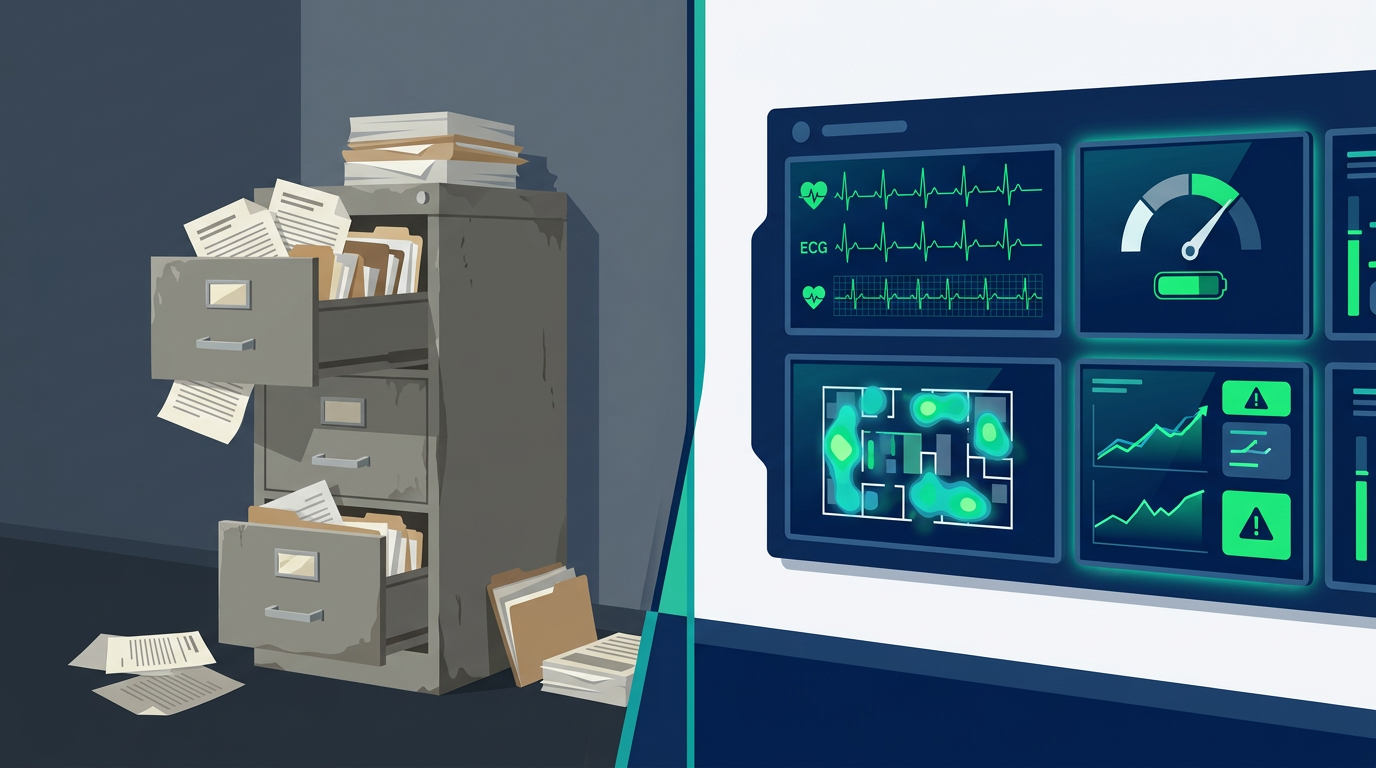
Your safety system is an incident archive, not an incident prevention system
Most EHS managers would say their safety program is proactive. Most would be wrong.
Every tool in the standard EHS stack -- incident reports, near-miss logs, CCTV replay, inspection checklists -- produces data about events that have already occurred. A worker was hurt, or almost hurt, or a hazard was spotted after the fact. The industry calls this "safety monitoring." A more accurate term is safety documentation.
Documentation is valuable. It satisfies regulators, informs audits, and surfaces patterns over months or quarters. But it cannot protect a worker whose fatigue is peaking on a Wednesday afternoon in July. By the time the incident report is filed, the harm is done.
The difference between monitoring and prevention
Prevention is not a faster version of documentation. It operates on a different logic entirely.
Documentation asks: What happened, and why? Prevention asks: What is happening right now, and what will happen next if nothing changes?
The gap between those two questions is where injuries live.
Why biometric data changes the equation
Continuous biometric monitoring is the clearest path from documentation to genuine prevention. When a worker's physiological state -- heart rate, body temperature, SpO2, blood pressure -- is captured and analyzed against baseline norms, the system gains something no incident report ever could: leading indicators.
A near-miss log records what almost happened. A biometric signal indicates what is becoming likely. That distinction is the difference between a rearview mirror and a dashboard.
This is the design premise behind HyperQ AI Safety from Hypernology. Rather than aggregating historical incident data for quarterly review, HyperQ AI Safety processes physiological and environmental signals continuously across the workforce.
The Smartband: wearable infrastructure for prevention
The hardware layer that makes this possible is the Smartband, integrated with HyperQ AI Safety and designed for continuous use in industrial environments. The Smartband collects the raw biometric stream: body temperature, heart rate, SpO2, and blood pressure. HyperQ AI Safety's models interpret it.
The result is a closed loop between individual worker state and organizational safety response that operates in minutes, not months.
What "safety monitoring" should actually mean
The EHS industry has settled on a definition of safety monitoring that would not survive scrutiny in other operational domains. In aviation, monitoring means real-time systems that intervene before failure. In workplace safety, monitoring has largely meant recording what goes wrong and reviewing it later.
That standard isn't inadequate because EHS professionals are careless. It's inadequate because, until recently, the technology to do better didn't exist at industrial scale.
Rethinking the safety stack
Organizations evaluating their EHS technology in 2026 should ask one diagnostic question of every tool in their stack: does this system act on signals before an event, or does it process data after one?
If the honest answer is "after," the tool is documentation infrastructure, not prevention infrastructure.
HyperQ AI Safety from Hypernology was built on the premise that the industry deserves a system that answers "before." The architecture is different. The intervention logic is different. The outcome -- a workforce whose risk state is known and managed in real time -- is categorically different from what any incident archive can offer.
Prevention is a design choice. Most workplaces are still choosing the archive.