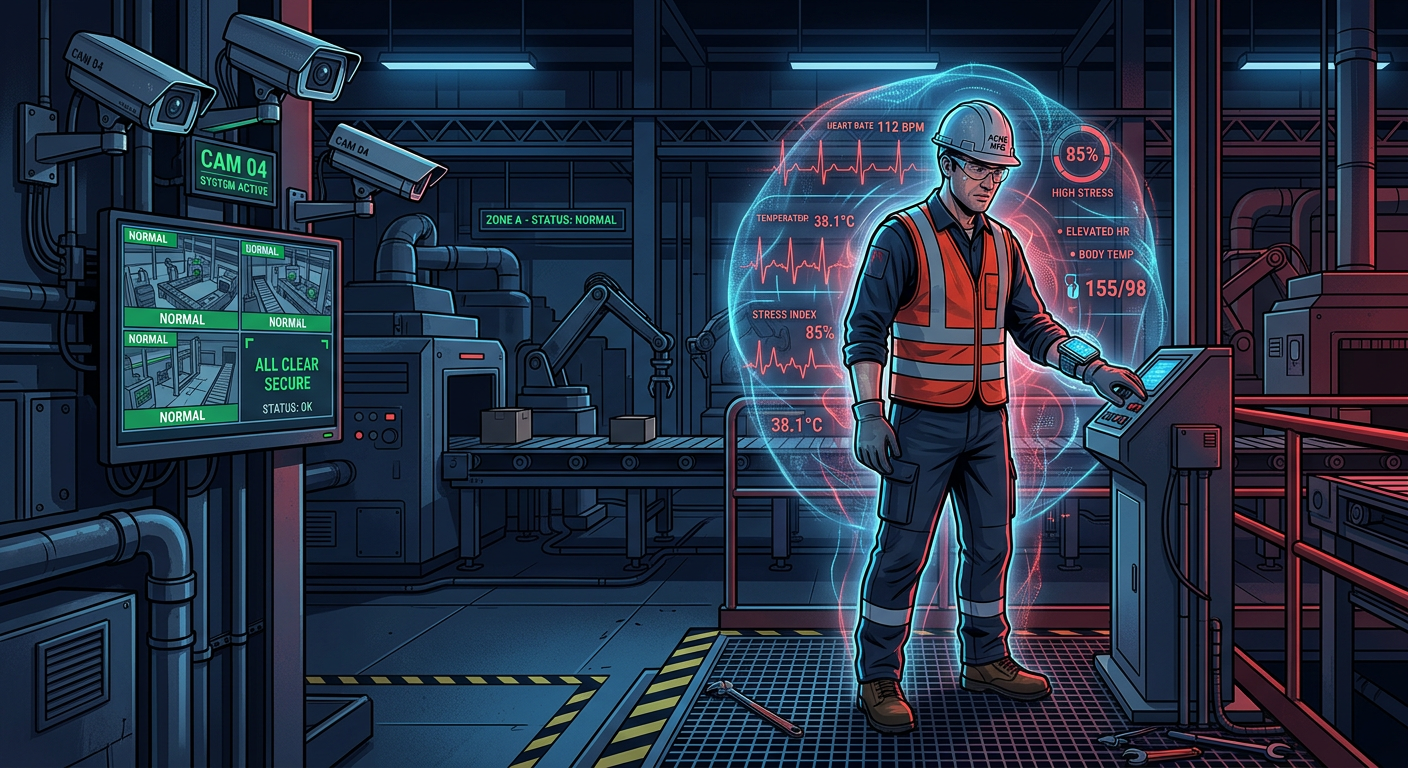
The biometric blind spot: why your safety technology cannot see the accident before it happens
The moment before most workplace accidents is invisible to every safety system your company has ever purchased. Not because the signals aren't there -- because no one is reading them.
What safety technology was built to see
Modern industrial safety infrastructure does one thing well: documenting events after they occur. Motion sensors trigger when a worker falls. Fire suppression activates when heat reaches threshold. Access control logs when an unauthorized person enters a zone. These systems share a common design philosophy -- they are reactive by architecture.
That is not a criticism. It is a structural fact. It explains why, despite decades of investment in safety technology, the injury rate in manufacturing, logistics, and construction has plateaued.
The pre-event window: where accidents are born
Occupational health researchers have documented a consistent pattern across thousands of workplace injury cases: the physiological deterioration that precedes an accident typically begins 60 to 120 minutes before any observable incident. Core body temperature climbs incrementally. Heart rate variability shifts in measurable ways. Hydration status degrades. None of these changes are dramatic. All of them are detectable.
This is the biometric blind spot: the gap between what the human body is signaling and what workplace safety systems are actually measuring.
What AI Smartband safety monitoring actually measures
The Smartband -- integrated with HyperQ AI Safety -- continuously captures biometric data: heart rate, body temperature, blood oxygen saturation (SpO2), and blood pressure. Individually, each data point is ambiguous.
The insight that changes the calculus is fusion. When multiple biometric streams are processed together -- and when that processing runs on AI models trained on occupational physiological data -- signal emerges from noise. Not "this worker's heart rate is high." Rather: "this worker's biometric profile has entered a pattern that precedes coordination-related incidents."
That is not an alarm. That is a forecast. Forecasts, unlike alarms, allow intervention.
HyperQ AI Safety from Hypernology is built around this distinction. The goal is not to detect the accident but to make the accident unnecessary.
The language your body speaks before you know you're at risk
HyperQ AI Safety translates these physiological signals into actionable operational intelligence. Supervisors receive risk-tiered alerts identifying not just who may be at risk, but what the physiological pattern suggests -- heat stress, fatigue accumulation, dehydration -- enabling targeted intervention. The Smartband delivers alerts via vibration directly to the worker while simultaneously notifying the control system.
Closing the blind spot: what implementation looks like
Organizations deploying biometric worker monitoring in manufacturing environments through HyperQ AI Safety typically move through three phases.
The first is baseline establishment: the platform learns the biometric norms of the workforce.
The second is predictive activation: the AI model begins generating pre-incident risk scores with sufficient confidence for operational use.
The third is cultural integration: safety practices shift from reactive documentation to proactive management.
The blind spot has a name now
The gap between what the human body signals and what workplace safety systems measure is a defined problem with a defined solution. Smartband integration -- powered by context-aware AI trained on occupational physiological data -- closes the biometric blind spot.
The workers whose core temperatures are rising right now -- in your facility, on your floor, during your shift -- are sending signals. HyperQ AI Safety from Hypernology is built to receive them.