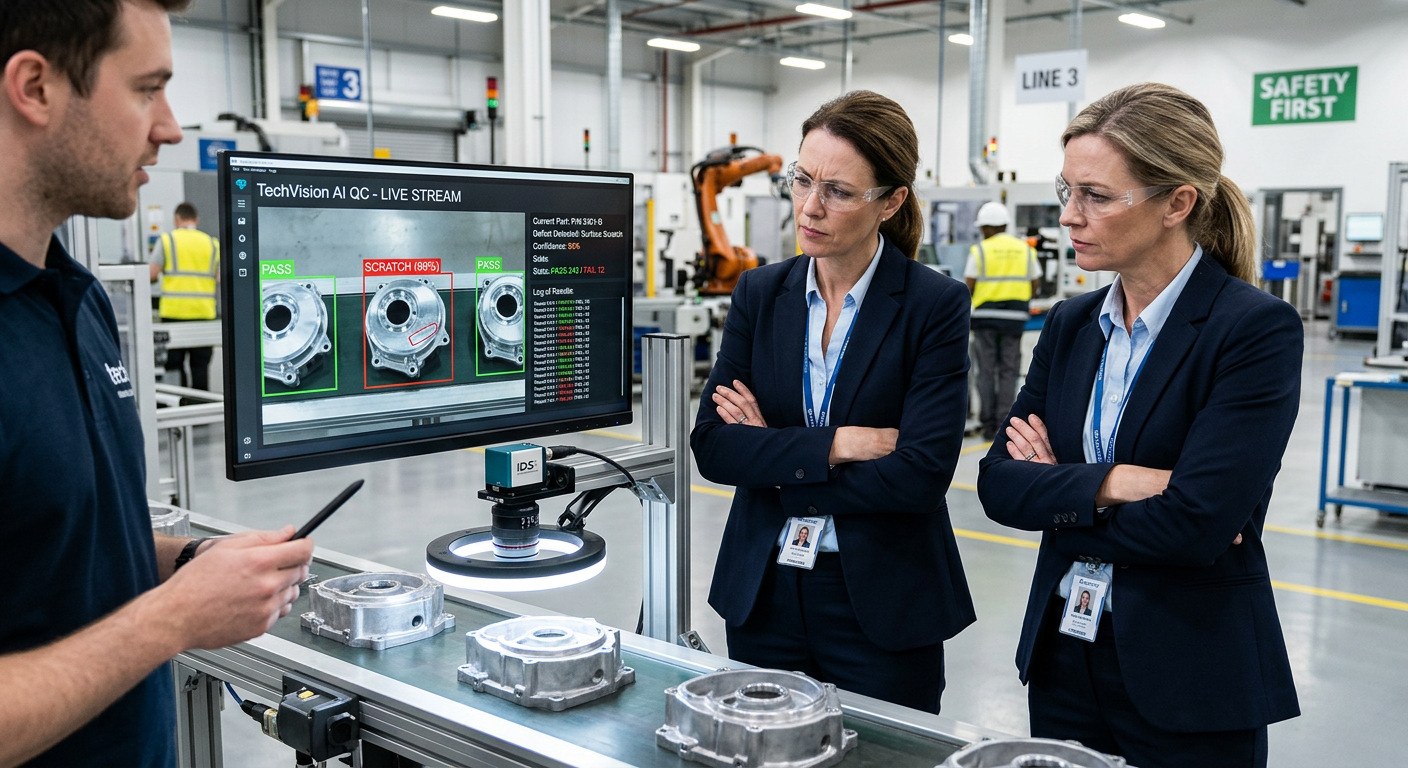
You Are Not Evaluating the System. You Are Watching a Rehearsal.
The demo looked impressive. The detection numbers were high. The defects appeared on screen exactly when they should have. The vendor's team answered every question confidently.
Six weeks later, the system was running on the actual production line -- and the quality manager was looking at a false positive rate that made the alerts nearly useless.
This outcome is not unusual. It is nearly the default. And the reason for it is not that the vendor was dishonest. It is that the evaluation process was structurally incapable of revealing the truth. This is the buyer guide problem for AI vision systems in manufacturing: the standard process does not test what matters.
Every AI vision vendor demo follows the same script. Controlled lighting environment. Product geometry the system has been trained on extensively. A pre-selected sample set of defect types -- including fabric defect inspection scenarios -- that the model handles well. Detection rates measured against that sample set, presented with confidence.
What is being demonstrated is not the system's capability on an uncontrolled line. It is the system's capability on the most favorable version of the problem it was built to solve. The gap between those two things can be enormous, and the standard evaluation process has no mechanism for surfacing it.
Asking an AI vision vendor to evaluate their own performance on their own sample data is functionally the same as asking a job candidate to provide references they selected themselves. The information you receive is real. It is just not representative.
Why does this happen? Not because vendors are setting out to mislead. It happens because the demo format is the industry norm, and buyers have largely accepted it. The quality manager watching the demonstration has usually not seen a failure mode yet. The system looks convincing. The vendor is professional. The reference customers speak well of the product.
The evaluation trap is structural. It exists because the thing you actually need to evaluate -- how the system performs on your product, your variants, your defect categories, your line conditions -- is almost never what is being tested during the sales process.
When evaluating AI vision systems for manufacturing, the variables that matter are specific to your operation. How does the system handle a new colorway it has not been trained on? What happens when ambient lighting shifts between morning and afternoon runs? How does it perform on your edge-case defect types -- the ones that are rare but consequential? What is the false positive rate under your actual conditions, not vendor-selected conditions? For fabric and textile manufacturers, this last question is often where systems that looked strong in demos fall apart.
These questions do not get answered in a standard demo. They get answered -- or not -- after deployment.
A practical AI vision system buyer guide for manufacturing comes down to one principle: evaluate on your production conditions, not on the vendor's sample library.
That means running the system on a representative sample of your actual product -- including variants, edge cases, and the defect types that matter most to your quality standards. It means measuring detection rates under your actual line conditions. It means asking the vendor directly: what happens on a product geometry or defect category this system has not been trained on? How does it adapt?
A vendor whose system is genuinely capable of handling uncontrolled production environments will not resist that kind of evaluation. They will welcome it, because it is the evaluation their system can pass and less capable systems cannot.
Hardware-bundled vision system providers -- the kind that require you to buy their cameras to run their software -- have a structural reason to resist this kind of evaluation. When camera compatibility is limited to their own hardware, an on-your-terms trial requires a capital commitment before you have seen real-line performance. That is vendor lock-in by design, and it should register as a red flag in any procurement process.
What changes when you run the evaluation on your own terms? You get signal instead of theatre. The detection numbers you see reflect your line, your defects, your constraints. The false positive rate you measure is the one you will actually live with. The edge cases the system handles -- or fails to handle -- are your edge cases, not someone else's pre-selected samples.
HyperQ AI Vision is designed to be evaluated against real production conditions. Universal camera compatibility means it can be tested on your existing line without a dedicated hardware setup. If you are evaluating AI vision systems for manufacturing, start the conversation at hypernology.net.