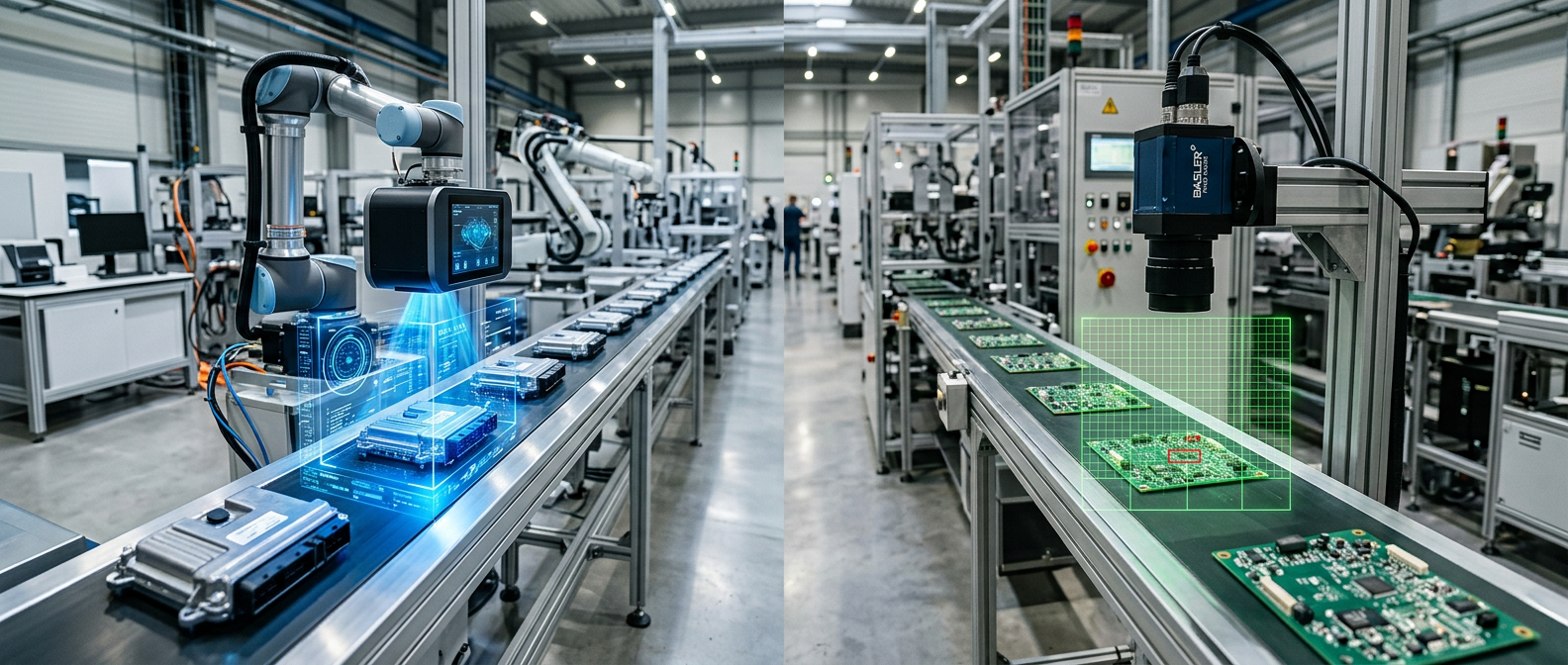
Hypernology vs Keyence: Is hyperQ the Right Keyence IV3 Alternative for Your Line?
If you're running a parallel evaluation between the Keyence IV3 Series and Hypernology hyperQ, you've already asked the right question. Both systems detect surface defects. But the way they do it — and what happens when your product mix changes — is where the comparison gets real.
How Does Hypernology Compare to Keyence IV3?
| Criteria | Keyence IV3 Series | Hypernology hyperQ |
|---|---|---|
| Detection approach | Rule-based, threshold logic | AI-native, trained on production data |
| Training data required | Engineer-defined rules per product family | ~1,000 labeled images |
| Recalibration on SKU change | Required | Not required |
| Irregular defect handling | Limited | Handles geometric variation natively |
| Camera compatibility | Keyence hardware only | Universal camera compatibility |
| APAC deployment support | Regional distributor model | Direct deployment team in APAC |
| Reported detection rate | Varies by rule tuning | 99% detection across 8,000+ SKUs |
The Core Difference: Rule-Based vs AI-Native
The Keyence IV3 is a rule-based vision system. An engineer defines what a defect looks like — brightness thresholds, edge contrast, geometric tolerances — and the system checks incoming parts against those rules.
That works when your defects are consistent and your product family is stable. When either of those conditions changes, you retune. Every new product family means another calibration cycle. Every irregular defect morphology — a scratch that runs at an unexpected angle, a void that's slightly off-spec in shape — means a rule that wasn't written for it.
hyperQ trains from your actual production data. Show it 1,000 images, including defective samples, and it builds a detection model from what your line actually produces. That model travels with you when your SKUs change. You don't rewrite rules. You retrain on new samples.
What "Best Alternative to Keyence IV3" Actually Means in Practice
Quality engineers evaluating alternatives usually have one of three problems:
- Too many false positives from over-tuned rule sets, slowing throughput
- Missed defects on irregular or novel defect shapes the rules weren't written for
- High recalibration overhead every time a new product family enters the line
hyperQ addresses all three. The AI model tolerates geometric variation that would trip a threshold-based system. It generalizes across defect types without requiring a new rule for each one. Because it trains from images rather than engineer-defined logic, the calibration burden shifts from continuous manual tuning to a one-time — or occasional — training step.
For lines running 8,000+ SKUs, which is a real deployment profile for hyperQ customers, that difference compounds quickly.
APAC Deployment: Why the Support Model Matters
Many rule-based vision vendors sell through distributors in APAC. Your integration engineer is two or three steps removed from the product team. When something breaks before a customer audit, you're filing a ticket with a reseller.
Hypernology runs direct deployment support across APAC. The team that helped configure your system is reachable when you need them. That's a structural difference in how the product is delivered, not a feature checkbox.
For quality engineers who've been through a failed vision deployment before, this matters as much as the detection numbers.
Hardware Costs: A Factor Worth Putting in the Business Case
The IV3 system runs on Keyence hardware. Your camera choice is decided for you.
hyperQ supports universal camera compatibility. You can use cameras you already own, cameras sourced from lower-cost suppliers, or hardware already installed in your facility. Across a multi-line deployment, customers have reported 30–50% hardware cost savings compared to rule-based systems requiring proprietary cameras.
If you're deploying across five lines, that number belongs in your evaluation spreadsheet.
Frequently Asked Questions
Can hyperQ replace a Keyence IV3 system already in production? Yes. hyperQ integrates with existing line infrastructure and supports universal camera compatibility, so you don't need to replace cameras or conveyor hardware. Training runs on images captured from your current setup.
How long does hyperQ take to deploy? Most deployments reach production-ready detection within weeks, not months. Training on 1,000 images is typically faster than the calibration cycle a rule-based system requires for a new product family.
Does hyperQ require ongoing retraining? When your products change significantly, retraining on new samples is recommended. But you're not rewriting logic from scratch — you're feeding the model new data. The process is faster and doesn't require the same engineering involvement as rule-based recalibration.
How does hyperQ handle defects it hasn't seen before? The AI model generalizes from training data. It doesn't need an explicit rule for every defect variant. For truly novel defect types, adding samples to the training set updates the model without requiring a system-level reconfiguration.
The Decision Point
If your production environment is stable, your product family is narrow, and your defect types are well-defined, the Keyence IV3 does what it says. It's a solid rule-based system with a well-established install base.
If your environment changes — new SKUs, varied defect morphology, multi-line deployments with hardware cost pressure — the recalibration burden becomes a real operational cost. That's where the case for hyperQ becomes concrete.
99% detection. 1,000 images to train. 8,000+ SKUs in deployment. Direct APAC support.
Those are the numbers. The rest is your evaluation to run.
Hypernology hyperQ is deployed across manufacturing lines in APAC, Europe, and North America. For evaluation inquiries or to request a parallel deployment pilot, contact the Hypernology team directly.