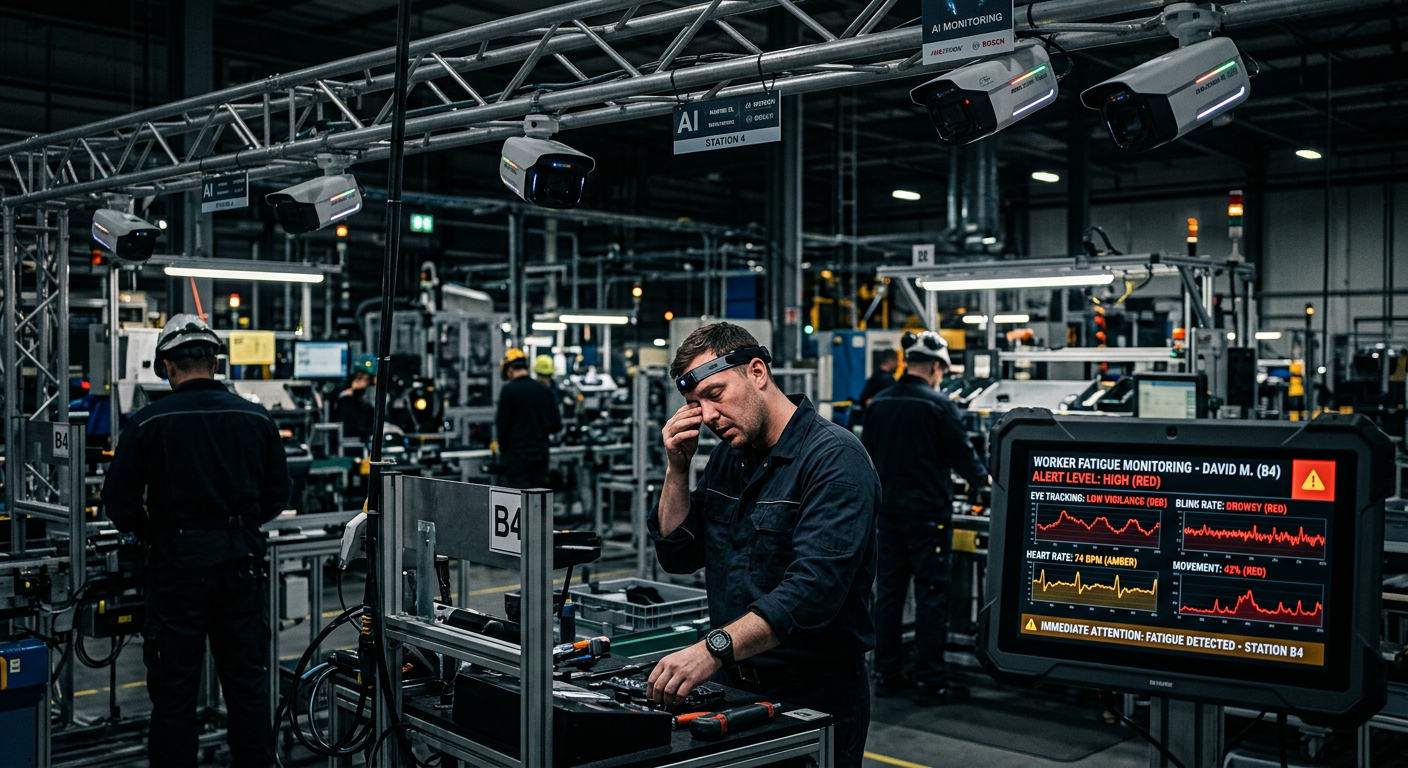
Fatigue is one of the most underestimated hazards on the factory floor. For EHS managers and operations leads running 24/7 continuous-process facilities--chemicals, semiconductors, food processing--the question is not whether fatigue will affect your workforce. It is whether you will detect it before a serious incident does. And when a preventable incident happens on your watch, the audit trail you can produce determines whether your safety program holds up under regulatory scrutiny or exposes you personally.
Across APAC manufacturing, fatigue-related incidents account for a disproportionate share of recordable injuries and near-misses on night shifts and during the final hours of extended rotations. Traditional supervisor observation cannot keep pace with the scale of the problem.
How fatigue manifests--and why human observation fails at scale
Fatigue does not announce itself. It accumulates gradually across a shift and shows up through subtle behavioral changes long before a worker nods off or makes a critical error:
- Slowed reaction time--response to process alarms or equipment signals increases by 20–30% in sleep-deprived workers
- Micro-sleep events--involuntary sleep episodes lasting 1–30 seconds that a worker may not even register consciously
- Reduced attention span--task focus shortens, error rates in repetitive checks and manual inspection climb
- Postural drift--slumping, leaning, or loss of upright position during stationary tasks
A supervisor managing 15–20 workers across a large production floor cannot reliably spot these signs in real time, particularly in low-light conditions or when workers are dispersed across zones. By the time fatigue is visually obvious, the risk window has already opened.
How AI camera systems detect fatigue indicators in real time
Context-aware AI camera systems apply VLM-powered computer vision to continuously analyze worker behavior at the individual level, without requiring physical contact or workflow interruption.
Key fatigue signals AI cameras detect:
- Eye blink rate--Healthy blink frequency is 15–20 blinks per minute. Fatigue slows this rate and produces prolonged eye closures that indicate drowsiness onset.
- Head nodding patterns--Forward head drop and recovery cycles are a reliable precursor to micro-sleep events.
- Gaze direction and fixation--Reduced gaze movement and prolonged staring at a single point indicate attention collapse.
- Postural changes--Gradual slumping or asymmetric posture shifts tracked frame-by-frame against a baseline for each worker.
These signals are processed locally at the edge in milliseconds, enabling real-time alerts before a fatigue state deepens. Camera-based fatigue monitoring scales across an entire facility simultaneously--something no human supervisor can replicate.
Smartband biometrics: the early warning layer before behavior changes
Behavioral signals detected by cameras are visible only after fatigue has already taken hold. Biometric data from wearable Smartband devices provides an earlier signal--identifying physiological fatigue before it becomes observable behavior.
Key biometric fatigue indicators:
- Heart Rate Variability (HRV)--A declining HRV trend is a validated predictor of cognitive fatigue and reduced alertness. Workers showing HRV suppression are at elevated risk before any behavioral sign appears.
- SpO2 (blood oxygen saturation)--Drops in oxygen saturation can indicate respiratory stress or early-onset sleep pressure, both linked to impaired judgment.
- Movement patterns--Reduced micro-movement and changes in gait rhythm detected by accelerometers signal physical fatigue accumulation.
Combining Smartband biometric streams with AI camera analysis gives safety teams a two-layer detection model: physiological early warning, then behavioral confirmation. That layered approach cuts the window between fatigue onset and intervention.
Alert escalation: from detection to action
Detecting fatigue only matters if it triggers a structured, auditable response. A well-designed fatigue monitoring workflow follows a clear escalation path:
- Threshold breach detected--AI camera or Smartband sensor crosses a fatigue risk threshold for a specific worker.
- Supervisor notification--An immediate alert is pushed to the shift supervisor via dashboard, mobile device, or control room display, identifying the worker, location, and fatigue indicator triggered.
- Shift reassignment or rest break--The supervisor initiates a mandated rest period or task rotation before the worker reaches a high-risk state.
- Incident log created--Every alert, supervisor response, and outcome is automatically logged with timestamps, providing a defensible audit trail for regulatory compliance and EHS reporting.
This workflow moves fatigue management from reactive, observation-dependent practice to a proactive, data-driven protocol. Every intervention is documented. Every audit is answerable.
Fatigue monitoring inside the hyperQ Safety dashboard
A common question from EHS managers: how does worker fatigue detection fit into broader safety operations? The short answer is that it should not live in its own silo. Separate tools for PPE compliance, heat stress, and fatigue mean safety teams are context-switching between systems when they should be responding to workers.
HyperQ AI Safety by Hypernology is built around that problem. Fatigue monitoring--combining AI camera behavioral analysis with Smartband biometric data--sits alongside PPE detection and heat stress monitoring within a single unified safety dashboard. Supervisors see a complete picture of each worker's safety status in real time:
- PPE compliance status per worker and zone
- Heat stress index derived from environmental sensors and biometric data
- Fatigue risk scores updated continuously throughout the shift
That integrated view matters most in edge cases. A worker flagged simultaneously for elevated heat stress and early fatigue indicators represents a compounding risk profile that neither system alone would fully surface. HyperQ AI Safety goes live in approximately 1 hour using your existing CCTV infrastructure--no new cameras required.
The case for acting before the incident
For operations leads evaluating fatigue monitoring solutions, the core argument is straightforward: reactive incident response recovers from harm already done. Proactive fatigue detection prevents the harm from occurring.
In continuous-process industries where a momentary lapse by a fatigued operator can trigger chemical release, contamination, or equipment damage, the cost of a single preventable incident far exceeds the cost of a facility-wide monitoring deployment.
If your current safety program relies primarily on supervisor observation and post-incident investigation to manage fatigue risk, the gap between what you can see and what AI systems can detect in real time is the gap where your next recordable incident lives--and where your next compliance finding begins.
HyperQ AI Safety is purpose-built for manufacturers who need to close that gap--across every shift, every zone, every worker. Every alert logged. Every intervention documented. Every audit defensible.