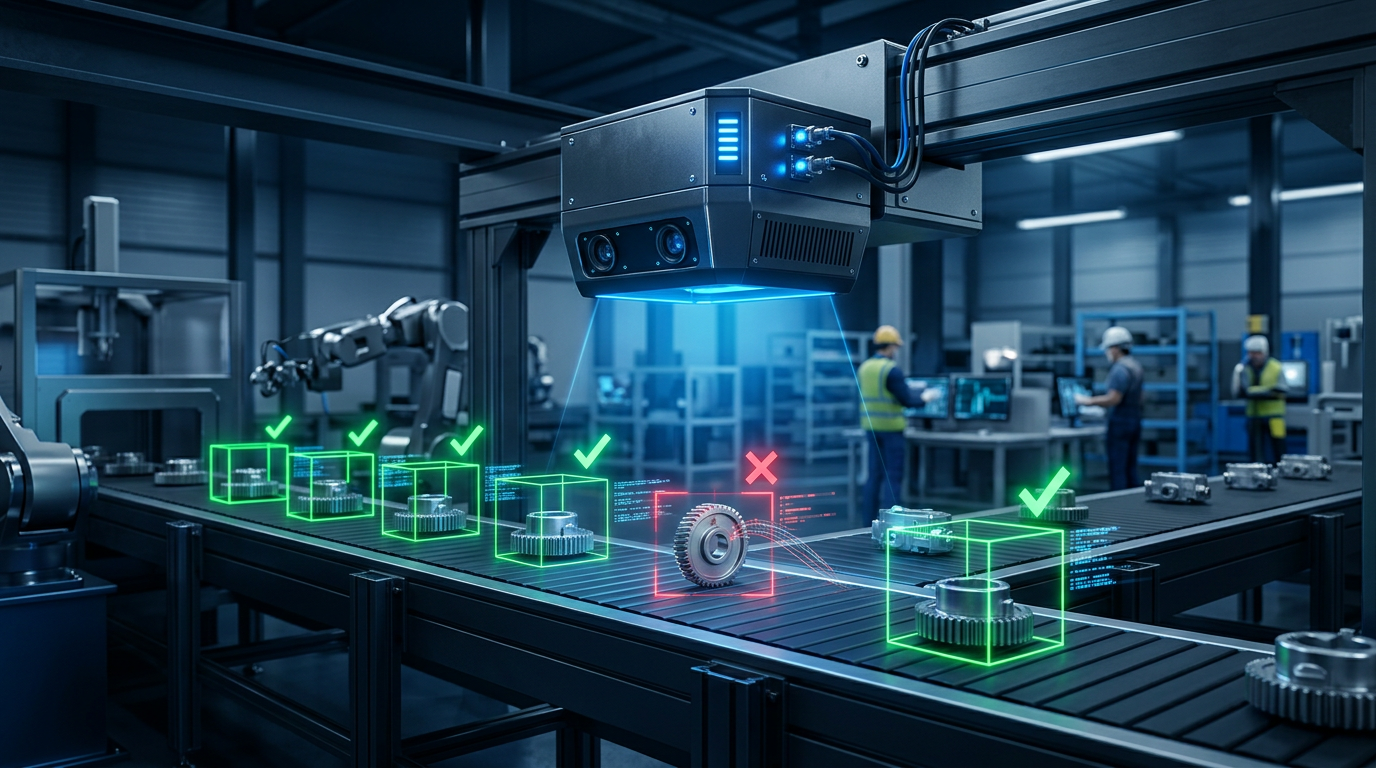
Manufacturing engineers evaluating AI-powered quality control solutions often encounter "industrial computer vision" alongside older terms like "machine vision." The difference matters when subtle defects are slipping through traditional systems and reaching customers.
What is industrial computer vision?
Industrial computer vision is AI-driven technology that lets machines interpret visual information from manufacturing environments. Unlike rule-based inspection systems, it uses deep learning algorithms trained on product images to recognize patterns, spot anomalies, and make quality decisions in real-time.
The difference: instead of relying on rigid pre-programmed rules, these systems learn what good and defective products look like from examples. This means they identify complex defects--micro-cracks, subtle color variations, irregular textures--that human inspectors and traditional systems regularly miss.
Manufacturing facilities using industrial computer vision report 60--80% reductions in false positives and catch defects that previously escaped to customers.
Machine vision vs computer vision: what's the real difference?
This is one of the most common questions from manufacturers exploring automated inspection. Here's the breakdown:
Rule-based machine vision
- How it works: Engineers manually program specific rules and thresholds for defect detection
- Best for: High-contrast, well-defined defects (missing components, dimensional checks, barcode reading)
- Limitations: Struggles with variable lighting, complex textures, or defects that don't fit predefined rules
- Setup time: Weeks to months of fine-tuning parameters for each product variation
- Adaptability: Requires re-programming when products or conditions change
AI-trained computer vision
- How it works: Neural networks learn to distinguish good from defective products using labeled image datasets
- Best for: Complex, subtle, or variable defects (surface imperfections, micro-cracks, color inconsistencies)
- Advantages: Handles lighting variations, adapts to product changes with retraining, reduces false positives
- Setup time: Days to weeks, with continuous improvement as more data is collected
- Adaptability: Retrained with new examples rather than re-engineered from scratch
The key insight: machine vision tells a camera what to look for. Computer vision teaches a system how to recognize quality.
What problems does industrial computer vision solve on the factory floor?
Manufacturing operations managers choose industrial computer vision when they face these specific challenges:
Detecting defects human inspectors miss
Fatigue, lighting conditions, and subjective judgment lead to inconsistent quality decisions. AI vision systems maintain 99% consistency across millions of inspections.
Reducing false rejects that waste good product
Rule-based vision systems often over-flag products to avoid missing defects, resulting in significant material waste. AI models learn the nuanced boundary between acceptable variation and true defects--60--80% false positive reduction compared to rule-based systems.
Catching micro-defects before they reach customers
Hairline cracks in molded plastics, subtle color shifts in printed packaging, or microscopic surface contamination--defects measured in microns that escape human eyes and rule-based systems.
Scaling inspection for high-speed production
When conveyor lines run at 100+ parts per minute, manual inspection becomes a bottleneck. Computer vision inspects at line speed without sacrificing accuracy.
Real-world example: detecting micro-cracks on a conveyor line
Consider a manufacturer of injection-molded automotive components. Parts exit the molding press at 120 units per hour and move down a conveyor line. Occasionally, microscopic stress cracks--barely visible to the naked eye--form during cooling.
The old approach: human inspectors spot-check 10% of parts, missing many micro-cracks. Those that slip through cause failures in customer assembly lines, triggering expensive warranty claims.
The rule-based attempt: engineers programmed a system to flag any dark line above a certain contrast threshold. Result: 40% false reject rate because natural material variations triggered false positives. The system was deactivated within 3 months.
The industrial computer vision solution: an AI vision system was trained on labeled images showing both acceptable surface variations and genuine micro-cracks. The system learned to distinguish between benign flow lines and actual structural defects.
Outcome:
- 99% defect detection rate
- 5% false reject rate (down from 40% with rule-based vision)
- Inspection at full line speed (120 units/hour with zero bottleneck)
- 11--18 months ROI through reduced warranty claims and material waste
This scenario plays out across industries--electronics, food packaging, pharmaceuticals, metal fabrication--wherever product quality depends on catching subtle visual defects that don't follow simple rules.
How to deploy industrial computer vision: 3 common approaches
When evaluating AI vision solutions, manufacturers typically encounter these deployment options:
Build in-house
Requires data science team, GPU infrastructure, and ongoing maintenance. Best for companies with deep ML expertise and highly specialized use cases.
Timeline: 6--18 months Upfront cost: $200K--$500K+
Traditional enterprise vision providers
Established machine vision vendors adding AI modules to existing platforms. Often requires extensive professional services and custom engineering.
Timeline: 3--6 months Upfront cost: $50K--$200K per line
Purpose-built AI vision platforms
Platforms like HyperQ AI Vision by Hypernology designed specifically for manufacturing quality control. These solutions offer pre-trained models for common defect types, low-code training interfaces, and edge deployment for real-time inspection.
Timeline: 4--8 weeks Upfront cost: free for pilot demo.
What manufacturing engineers should prioritize: look for solutions that allow your team to retrain models as products change, provide explainable AI outputs showing why a defect was flagged, and integrate with existing MES/ERP systems for traceability.
Key takeaways for manufacturers evaluating AI vision
Industrial computer vision uses AI to learn defect patterns, while traditional machine vision uses fixed rules. This makes AI-based systems more adaptable to complex, subtle defects.
The technology excels at detecting micro-defects that human inspectors and rule-based systems miss--directly reducing warranty costs and customer complaints. False reject rates drop 60--80% compared to traditional vision systems, preserving material and reducing waste.
Deployment timelines range from weeks to months depending on approach--purpose-built platforms offer the fastest path to production.
For manufacturers dealing with high-mix production, subtle defects, or frequent product changes, industrial computer vision offers a practical path to automated quality control that actually works. The technology has matured past the experimental stage. It's a proven tool for companies that need consistent, accurate inspection at scale.
If you're evaluating AI vision for your facility, start by documenting your top 3--5 defect types, typical production volumes, and current false reject rates. This baseline data will help you assess which deployment approach makes sense for your operation.