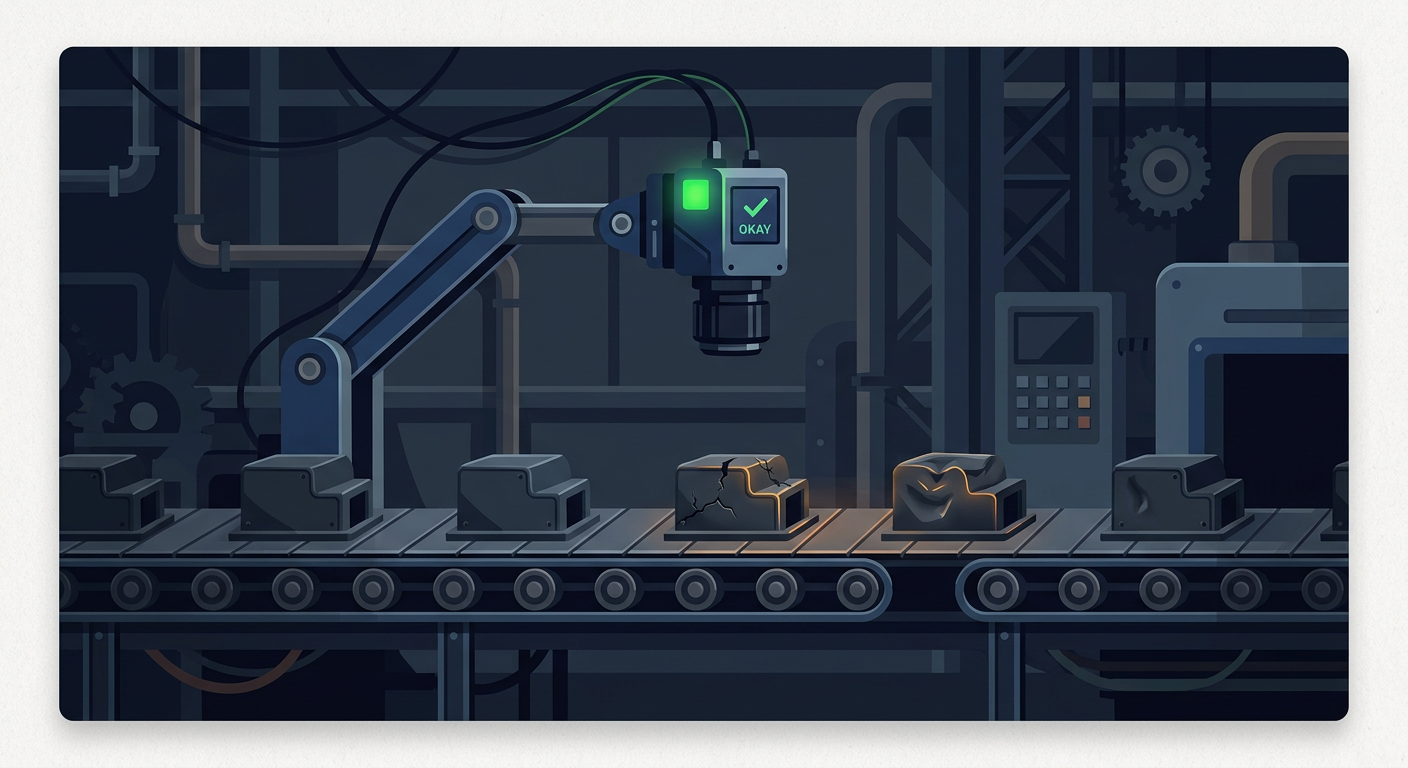
The silent failure mode of rule-based vision
Rule-based vision doesn't fail loudly. It fails by passing defects your engineers never taught it to recognize.
That distinction matters more than most manufacturers realize -- because silent failures are the ones that reach customers, trigger recalls, and erode brand trust before anyone inside the facility knows something went wrong.
What rule-based vision systems actually do
A rule-based machine vision system operates on explicit, human-defined logic. An engineer examines known defect types, writes conditions to detect them, and deploys the system. From that moment forward, the system is frozen in time. It will reliably catch every defect it was programmed to catch. It will silently pass every defect it was not.
This is not a configuration error. It is the fundamental architecture of rule-based inspection.
The structural blind spot
Consider a common production scenario. A component ships without issue for six months after a rule-based vision system is deployed. Then product geometry shifts slightly -- a supplier changes a tolerance, a mold ages, a material batch varies. A new surface anomaly begins appearing. It is subtle. It is real. And the rule-based system has no rule for it.
The defect passes inspection. Every unit. Every shift. No alarm. No log entry. Just shipments.
This is the enemy: not the engineer who wrote the original brief, but the system that cannot learn anything new after that brief was written.
Why this risk compounds over time
Rule-based systems lose relevance as production environments evolve. The longer a system runs without a rules update, the wider the gap between what it was designed to catch and what it actually needs to catch. This gap is invisible to standard reporting.
The conversation around a modern machine vision alternative in APAC is not primarily about cost or supplier diversification. It is about whether the inspection architecture itself can keep pace with modern manufacturing complexity.
What AI-based vision changes
HyperQ AI Vision, developed by Hypernology, is built on a different premise. Rather than encoding fixed rules about known defect categories, HyperQ AI Vision learns the visual signature of a conforming product and flags statistical deviations from that baseline -- including anomaly types that were never labeled, named, or anticipated during training.
HyperQ AI Vision narrows the gap between what the system was trained on and what the production line is currently producing.
The questions manufacturers should be asking
If your facility runs rule-based vision, the right operational question is not "Is our system catching defects?" It is: "What defect types could be passing right now that our system was never programmed to recognize?"
HyperQ AI Vision from Hypernology is built for manufacturers who have started asking that question -- and who need an inspection architecture capable of learning continuously rather than remaining frozen at the moment the last rules update was written.
The enemy has always been the architecture
Rule-based machine vision works well for stable, well-characterized defect profiles. It is a poor fit for production environments that evolve. The silent failure mode it creates is not a bug that can be patched -- it is an inherent property of systems that require human foresight to define every recognizable failure before deployment.
HyperQ AI Vision addresses this structural limitation directly. The system learns what good looks like. Everything that deviates -- including categories no engineer anticipated -- becomes detectable.
In manufacturing quality, the failures you never see are the most dangerous ones.