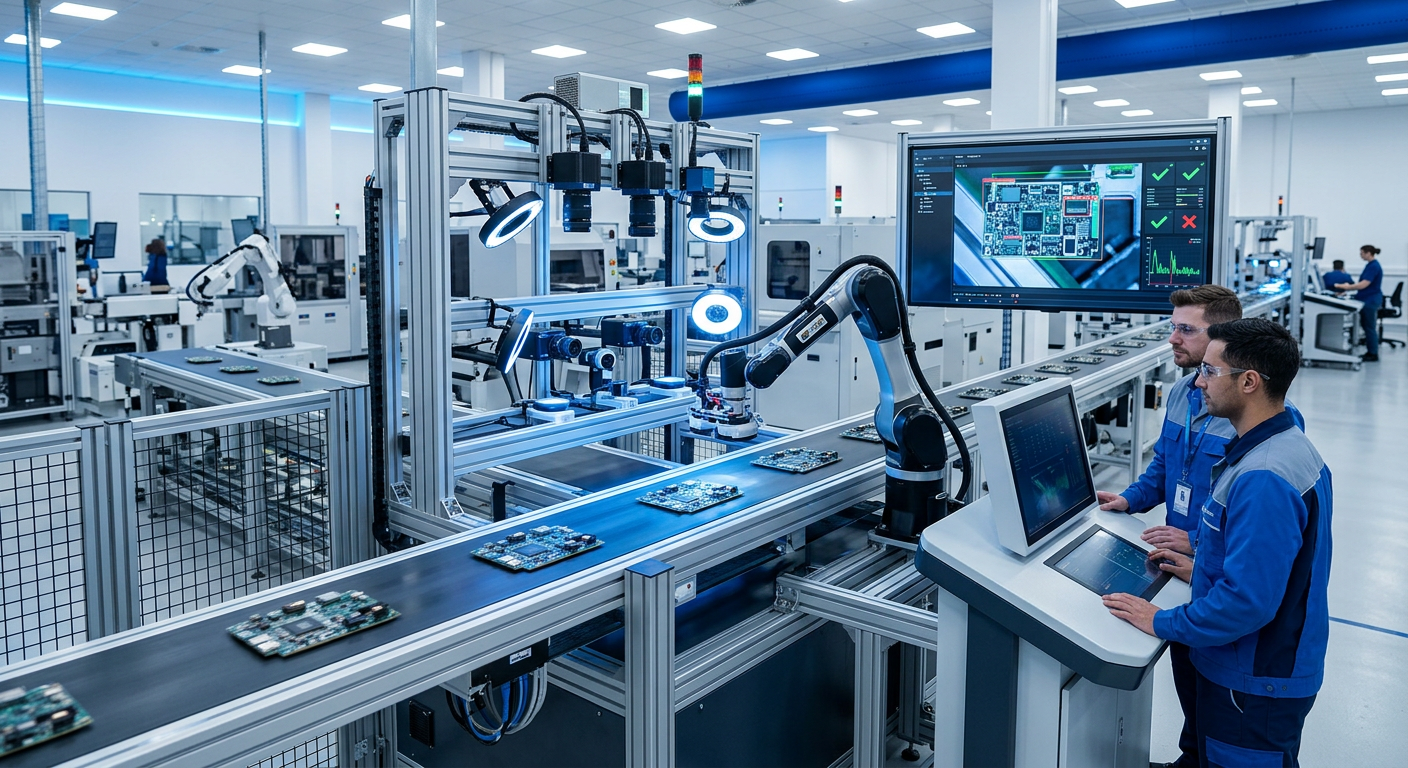
HyperQ AI Vision delivers production-grade defect qualification at line speed. No hardware replacement required.
The inspection bottleneck
Manual inspection limits throughput. One electronics manufacturer ran 40 units per hour with manual checks, scaled to 60 units per hour with rule-based vision systems, and hit 270 units per hour with HyperQ AI Vision--without adding inspection staff.
The constraint isn't labor availability. It's detection consistency at speed.
What HyperQ AI Vision delivers
99% defect detection rate across surface defects, dimensional variance, assembly errors, and packaging anomalies. Real-time flagging with visual confirmation of what failed and why.
Defect qualification, not just detection. The system identifies, categorizes, and prioritizes defects based on your tolerance specifications. You define what matters. HyperQ AI Vision enforces it.
Universal camera compatibility means you deploy on existing CCTV infrastructure. No proprietary hardware lock-in. No equipment replacement costs. Deploy in approximately 1 hour for safety monitoring, 30 minutes for pattern inspection.
How it works differently
Most vision systems require 10,000 labeled images to train a single defect model. HyperQ AI Vision uses a patented training method that achieves production accuracy with 1,000 images--90% less training data, 60-80% faster deployment.
The system adapts to 8,000+ product models without retraining from scratch. Add a new SKU, provide sample images, and start inspecting within 30 minutes.
Context-aware defect assessment means the system understands production tolerances, not just image patterns. A scratch on a hidden surface gets flagged differently than one on customer-facing packaging. You control the rules. The system applies them consistently.
Built for manufacturing reality
Food and beverage lines running packaging inspection at 200+ units per minute. Consumer goods manufacturers managing 8,000 SKUs across seasonal product rotations. Industrial component producers where a single escaped defect triggers a batch recall.
HyperQ AI Vision operates in these environments today.
Hardware cost savings: 30-50% compared to rule-based vision systems requiring proprietary cameras. False positive reduction: 60-80% compared to threshold-based detection. Full implementation: 4-8 weeks from contract to production deployment. ROI: 11-18 months.
What you avoid
Vendor lock-in through proprietary hardware requirements. Multi-month training cycles to achieve production accuracy. Detection systems that flag everything and qualify nothing. Inspection bottlenecks that force the choice between speed and quality.
HyperQ AI Vision removes those constraints.
This week
We're releasing the technical details: deployment architecture, training methodology, integration requirements, and performance benchmarks.
You'll see how the system trains on 1,000 images instead of 10,000. How it qualifies defects in real time without slowing throughput. How it deploys on existing camera infrastructure in under 1 hour.
Because introducing a product name is one step. Proving it works in production environments is what matters.
HyperQ AI Vision: production-grade defect qualification without hardware lock-in. Developed by Hypernology for manufacturers who measure quality in detection rates, not promises.
Ready to evaluate HyperQ AI Vision for your line? Contact us for a technical discussion.