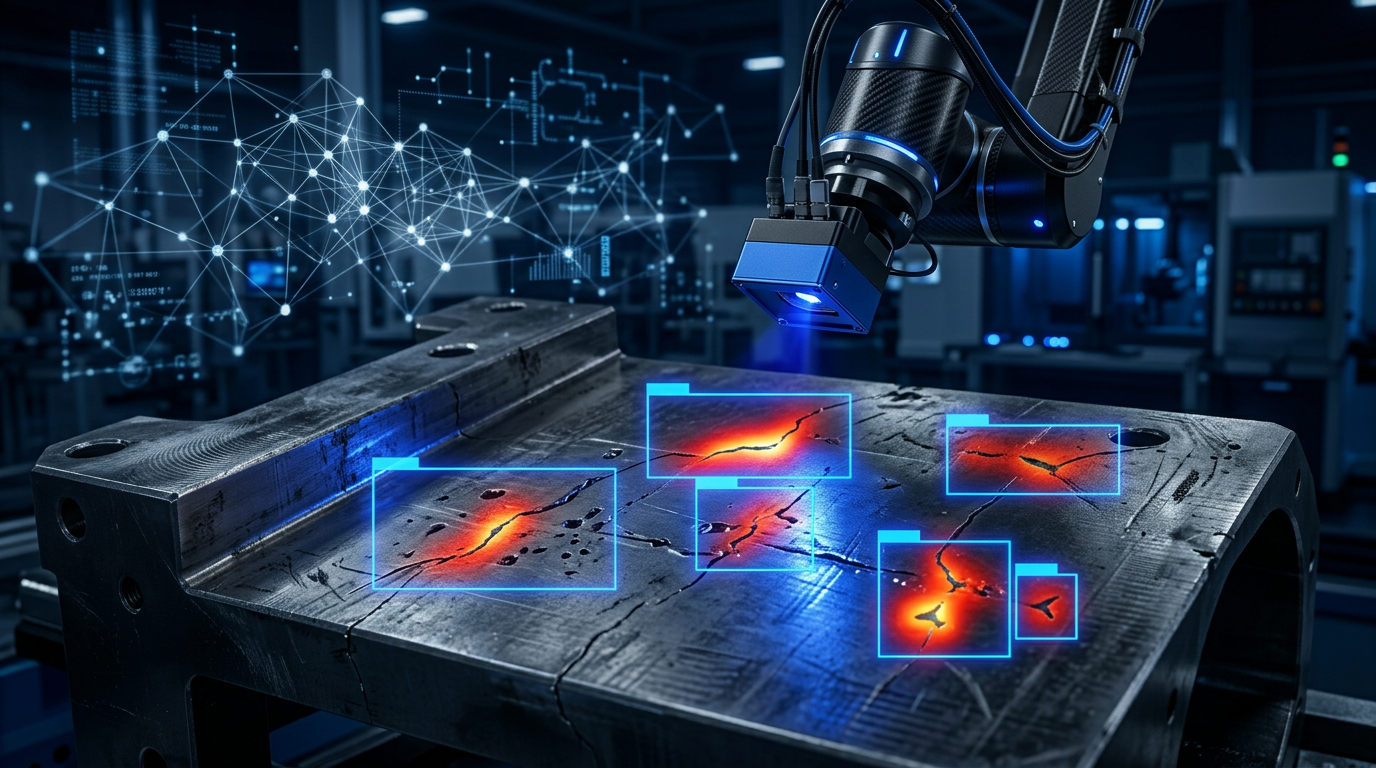
If you deploy traditional machine vision systems, you've encountered this problem: rule-based inspection catches scratches and dimensional deviations reliably, but irregular defects keep slipping through. Cracks with unpredictable branching patterns, delamination that varies in texture, contamination spots with no consistent shape--these escape at rates exceeding 2.3% in production environments.
The issue isn't camera resolution or lighting. It's what happens when rule-based logic meets defect morphologies that don't follow predictable patterns.
Why rule-based vision systems struggle with irregular defects
Traditional machine vision relies on explicitly programmed rules: "If edge contrast exceeds threshold X" or "If blob area falls outside range Y-Z." This works for geometric defects like missing components, dimensional errors, and alignment issues because these follow predictable structures.
Irregular defect detection with AI operates differently. Here's where rule-based approaches break down:
The dataset paradox
Rule-based vision systems require engineers to manually define threshold parameters for every defect type, collect massive defect libraries--often 10,000+ images--to cover morphological variations, create separate inspection recipes for each defect category, and continuously tune parameters as defect presentations evolve.
Even after this investment, novel defect morphologies trigger false negatives. A 2.3% escape rate is common in production environments handling complex defect inspection, translating to thousands of defective units shipped annually in high-volume manufacturing.
The generalization gap
When a scratch appears at 47 degrees instead of the 45-degree template you programmed, does your system catch it? When delamination presents with 30% transparency variation from your threshold, does it trigger an alert?
Rule-based systems encode rigid boundaries. AI-trained models learn feature representations--the underlying visual patterns that define defect characteristics regardless of exact manifestation.
How AI inspection works with 1,000 images
Modern irregular defect detection with AI uses deep learning architectures trained to recognize defect patterns from representative samples rather than exhaustive catalogs. The practical workflow looks like this:
Training phase requirements
Dataset size: 1,000 images versus the 10,000+ images rule-based vision vendors require for comparable coverage, plus the added burden of manual rule tuning for each defect subcategory.
Distribution: 700 images for training, 200 for validation, 100 for final testing.
This 90% training data reduction is backed by patented technology that enables low-data learning.
What the AI learns
Unlike rule-based systems checking pixel values against thresholds, AI models trained for complex defect inspection learn hierarchical feature extraction--early layers detect edges and textures while deeper layers recognize defect patterns across transformations like rotation, scale, and lighting variation.
The models understand contextual relationships: a crack near a stress point versus isolated contamination. They learn anomaly detection boundaries--what "normal" looks like with enough nuance to flag deviations that don't match any pre-programmed defect profile.
This is defect qualification, not just detection. HyperQ AI Vision determines whether a scratch is acceptable or unacceptable based on your specific quality standard--not just whether a scratch exists.
Real-world performance metrics
Manufacturing environments deploying AI inspection systems for irregular defects report escape rate reduction from 2.3% (rule-based baseline) to below 0.05%, false positive rates of 0.8--1.2%--comparable to or better than traditional systems after tuning--and deployment timelines of 4--8 weeks from data collection to production validation versus 8--12 weeks for traditional recipe development.
Technical implementation: before and after comparison
Before: rule-based approach
A mid-sized electronics manufacturer inspected PCB solder joints with a traditional vision system using 47 programmed rules checking for solder bridge width, joint circularity, and pad coverage percentage. They maintained a defect library of 8,200 labeled images but still experienced a 2.3% escape rate--primarily irregular defects like incomplete wetting with variable surface texture and micro-cracks in solder fillet.
Maintenance burden: 6 hours per week adjusting thresholds as solder paste supplier variations introduced new appearance modes.
After: AI vision deployment
The same manufacturer deployed HyperQ AI Vision trained on irregular defect patterns using a training dataset of 1,000 images captured across 3 production shifts to capture lighting and part positioning variation.
The model architecture--a convolutional neural network with attention mechanisms to focus on defect-relevant regions--achieved an escape rate of 0.04% after 4 weeks in production. The system flagged a previously unseen defect type (cold solder joint with oxidation layer) that didn't match any programmed rule, catching it in validation before customer shipment.
The difference: the AI model generalized from learned patterns rather than matching against explicit templates.
Why 1,000 images outperform 10,000-image systems
This seems counterintuitive. How can 1,000 images outperform systems built on 10,000+ examples? The answer lies in transfer learning and feature representation.
Transfer learning foundation
Modern AI inspection models start with pre-trained weights from large-scale image datasets. The model already understands edge detection, texture analysis, shape recognition, and spatial relationships.
Your 1,000 manufacturing images fine-tune this foundation to recognize defect-specific patterns--not build visual understanding from scratch.
Representation learning versus template matching
Rule-based systems store templates: "Defect A looks like this exact pattern." You need thousands of examples to cover pattern variations.
AI models learn representations: "Defects share these underlying characteristics." The model interpolates between learned examples, detecting defect variations it has never seen in training data.
This is why AI inspection with minimal defect data works better for irregular defect detection. It's not memorizing patterns--it's understanding visual features.
Practical considerations for quality engineers
If you're evaluating irregular defect detection with AI for your production line, focus on these implementation factors:
Data quality over quantity
Your 1,000 training images should represent true production variability (different shifts, batches, lighting conditions), include edge cases and borderline defects where human inspectors debate accept/reject decisions, and capture part orientation and positioning variation.
Defect taxonomy definition
AI systems benefit from clear defect categorization: critical defects (immediate reject), major defects (evaluate in context), and cosmetic issues (customer-specific criteria). Unlike rule-based systems requiring separate recipes, a single AI model can learn multi-class classification across defect types.
Integration with existing workflows
Modern AI vision platforms like Hypernology's HyperQ AI Vision integrate with existing camera hardware--no need to replace functioning optics--MES/ERP systems for defect tracking and trend analysis, and human verification workflows for continuous model improvement.
Universal camera compatibility delivers 30--50% hardware cost savings versus locked ecosystems.
When to choose AI over rule-based inspection
Both approaches have valid use cases. Choose irregular defect detection with AI when defect morphology varies unpredictably (cracks, delamination, surface texture anomalies), you lack large defect datasets or defects are rare (making dataset collection impractical), new defect types emerge regularly (product design changes, supplier variations), or inspection criteria include subtle variations difficult to encode as threshold rules.
Continue using rule-based systems for high-volume geometric inspections (presence/absence, dimensional checks), applications where defect definitions are legally mandated and must be auditable as explicit rules, or environments where AI model updates require extensive revalidation (highly regulated industries).
For many manufacturers, a hybrid approach works best: rule-based systems for structured defects, AI models for irregular defect detection.
The path from 2.3% escape rate to industry-leading quality
Getting defect escape rates below 0.05% takes more than technology. It requires systematic quality data collection, model training, and continuous improvement.
Quality engineers deploying AI inspection systems report that the biggest challenge isn't the AI itself--it's organizational readiness: getting production teams to trust model predictions, establishing feedback loops when the AI flags uncertain cases, and maintaining labeled datasets as product designs evolve.
The technical capability exists today. The question for manufacturing leaders: how much longer can you afford a 2.3% escape rate when proven alternatives deliver 50x improvement?
Ready to explore AI inspection for your production line? Hypernology's HyperQ AI Vision platform is built for complex defect inspection applications where traditional systems struggle. Contact our engineering team to discuss your specific irregular defect challenges and see a customized proof-of-concept using your actual production data.