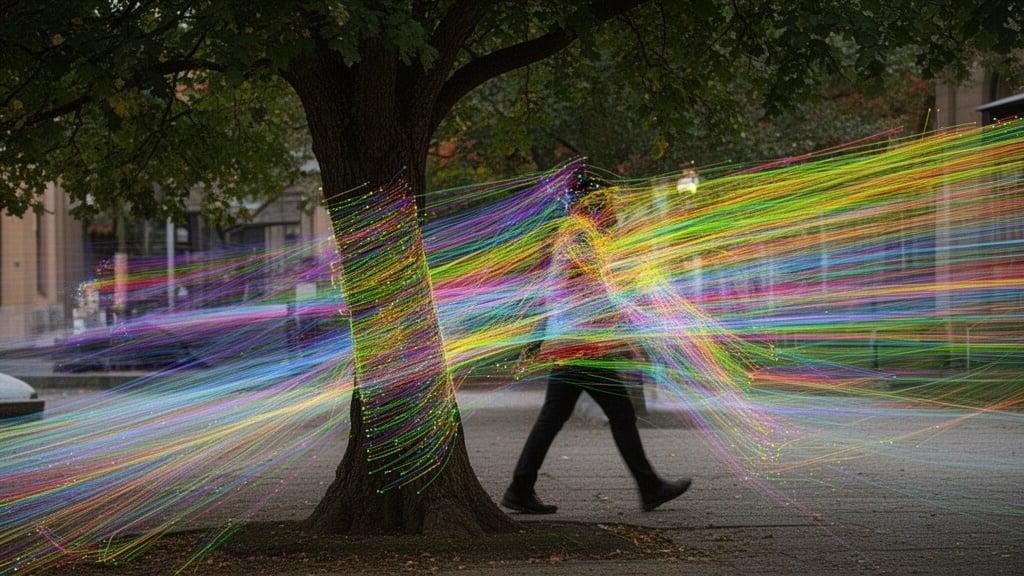
A course project. No money for training massive models. So: take a frozen optical flow model, inject semantic features from a frozen Vision Transformer, and see what happens.
Result: diffusion-quality video interpolation at 25 FPS. An order of magnitude faster than diffusion models.
The Problem Flow Models Have
Optical flow models like RIFE are fast. They estimate pixel motion between frames and generate the in-between frames accordingly. But they're blind to semantics. They track pixels without understanding what those pixels represent.
When an object disappears behind something (occlusion), flow models fail. They don't understand that a person walking behind a tree is still a person who will reappear. They just see pixels that vanish and guess poorly at what comes next.
Diffusion models handle this better. They have semantic understanding—they know what objects are and how they behave. But diffusion is slow. Too slow for real-time video processing.
The Hybrid Approach
Instead of training a new model from scratch, the researcher combined two frozen models:
- RIFE: Fast optical flow estimation
- DINOv3: Semantic feature extraction from Vision Transformers
The idea: use DINOv3's semantic understanding to refine RIFE's coarse flow output. The Vision Transformer provides context about what's in the scene. The flow model handles the motion. Together, they produce high-quality interpolated frames.
Performance metrics:
- LPIPS (perceptual similarity): 0.047—matches SOTA diffusion models
- Speed: ~25 FPS on Colab L4 GPU
- Quality: Sharp textures without massive latency penalty
The trade-off: when flow estimation fails, you get a "sharp, textured catastrophe" instead of a blurry mess. But in most cases, the semantic guidance prevents those failures.
Why Foundation Models as Priors
This pattern is appearing across computer vision: using pre-trained foundation models as semantic priors for specialized tasks.
Foundation models like DINOv3 are trained on massive datasets. They learn rich representations of visual concepts. But they're not optimized for specific tasks like video interpolation.
Specialized models like RIFE are optimized for specific tasks. But they lack semantic understanding.
Combining them gets you both: task-specific optimization plus semantic awareness. And you don't need to train a massive model from scratch. You use existing frozen models and add a small learned layer to connect them.
This is computationally cheap. It's accessible to individuals without massive compute budgets. And it works.
What This Says About the Current Moment
Five years ago, this approach wouldn't have worked. Foundation models weren't good enough. Pre-trained features weren't rich enough. You'd need to train end-to-end.
Now the foundation models are so capable that you can treat them as components. Frozen building blocks. You focus on the connection logic, not the core model training.
The researcher describes this as "using Foundation Models as priors on VFI." It's a design pattern: take semantic understanding from a general model, apply it to a specialized task.
Similar approaches are emerging across the field:
- RF-DETR uses DINOv2 backbone and gets free performance boosts
- CoTracker uses deep features for point tracking across large frame gaps
- Multiple projects inject semantic features into specialized architectures
The pattern is consistent: semantic understanding from foundation models improves specialized systems without requiring full retraining.
Speed vs. Quality: The Persistent Trade-off
This project achieves diffusion-quality results at flow-model speeds. That's the claim. But "quality" is context-dependent.
For smooth motion of well-tracked objects: excellent. For heavy occlusion or complex scene changes: the semantic features help, but flow estimation still fails sometimes. For 1 FPS input (large motion between frames): the current approach breaks. Flow models need temporal continuity. When frames are too far apart, pixel tracking fails regardless of semantic understanding.
The researcher acknowledges these limitations clearly. The system acts as a "texture corrector" not a "motion guide." If underlying flow fails, semantic features just paint sharp textures in the wrong place.
This matters for application design. If you're processing high frame rate video with predictable motion, this approach excels. If you're dealing with sparse frames or discontinuous motion, you need different architectures.
The Accessibility Angle
"No money lol." That phrase reveals something important. This breakthrough came from resource constraints, not massive budgets.
The researcher couldn't train a large model from scratch. So they found a way to combine existing models cleverly. And achieved competitive results.
This is what happens when foundation models commoditize semantic understanding. The barrier to entry drops. Graduate students can compete with research labs.
Whether this is good or bad for the field is unclear. It's definitely different from the trajectory five years ago, when cutting-edge computer vision required institutional compute access.
Questions About Generalization
How well do these semantic features transfer across domains? DINOv3 was trained on general image datasets. Does its semantic understanding translate to specialized content—medical imaging, satellite imagery, thermal video?
What happens with unusual visual styles? Animation, stylized video, abstract art. Do the semantic features still provide useful guidance, or do they assume photorealistic content?
How does this scale to higher resolutions? 25 FPS is impressive at standard resolutions. Does it maintain that speed at 4K? Do semantic features provide proportionally more benefit at higher resolutions where flow estimation has more room to fail?
These aren't answered yet. They're the questions that determine where this approach works well versus where it breaks down.
The Broader Pattern
This project exemplifies a shift in how computer vision research operates:
Old paradigm: Design a novel architecture, train on massive datasets, publish benchmarks.
New paradigm: Combine existing foundation models cleverly, add small learned components, achieve competitive results without massive compute.
The bottleneck is moving from model capability to architectural creativity. How do you compose existing powerful components into systems that solve specific problems better?
That's a different skill set. Less about training infrastructure and GPU clusters. More about understanding what different models are good at and how to connect them effectively.
What Gets Built Next
If semantic features can guide optical flow this effectively, what other specialized vision tasks benefit from the same pattern?
Depth estimation + semantic understanding? Object tracking + scene understanding? Video stabilization + content awareness?
The researcher's blog post describes the architecture in detail. The interesting question isn't just "does this specific combination work" but "what general principle does this reveal about composing vision models."
Foundation models provide semantic priors. Specialized models provide task-specific optimization. The connection layer learns how to apply semantic understanding to specialized tasks.
That's a recipe. The question is how many problems it applies to.