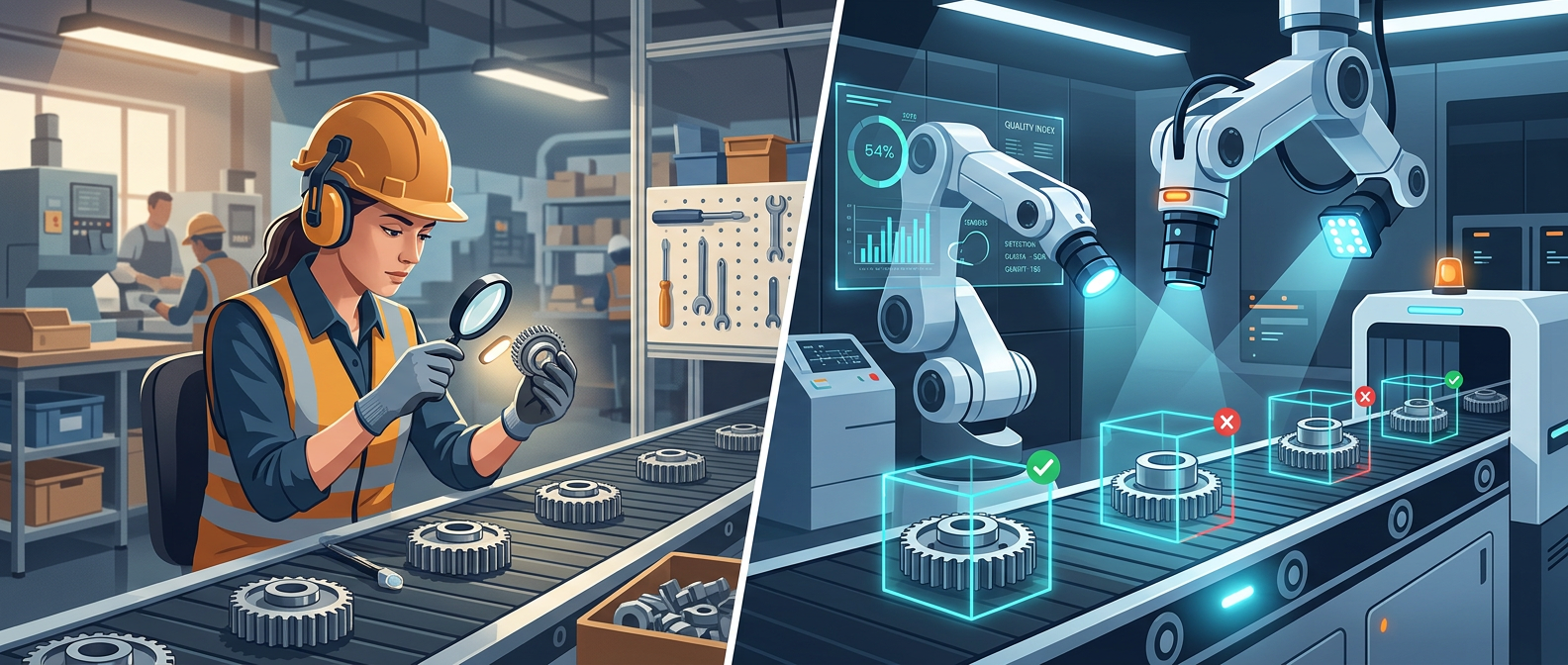
AI vision vs traditional quality control: a direct comparison for operations directors
If you're an operations director or quality manager evaluating inspection approaches, you're likely asking the same question: which method actually delivers the best defect detection, lowest cost, and fastest ROI for my specific line?
This post gives you a direct, data-backed comparison of the three main inspection methods -- manual inspection, rule-based machine vision, and AI vision -- so you can make a financially defensible decision.
The three inspection methods at a glance
1. Manual inspection
Human inspectors examine parts visually, often with magnification aids or tactile checks.
- Throughput: 200-600 parts/hour per inspector, depending on part complexity
- Escape rate (defects passing through): 15-25% under sustained fatigue conditions; 5-10% under optimal conditions
- False reject rate: 3-8% (human variance, lighting changes, end-of-shift fatigue)
- Setup time: Days to weeks for training new inspectors
- Cost structure: High recurring labor cost; no capital outlay; scales linearly with volume
- Best-fit conditions: Low-volume, high-mix production; highly irregular or subjective defect criteria; parts that require contextual human judgment; operations under 200 parts/day
Manual inspection is not obsolete. For prototype runs, custom fabrication shops, or lines producing fewer than 200 parts/day, it remains the most economical and flexible option.
2. Rule-based machine vision
Traditional machine vision uses cameras, lighting rigs, and deterministic algorithms (edge detection, pattern matching, blob analysis) to inspect parts against fixed geometric tolerances.
- Throughput: 1,000-10,000+ parts/hour with proper line integration
- Escape rate: 2-5% for well-defined, consistent defects; rises sharply when defect morphology varies
- False reject rate: 5-15% on lines with natural variation in part presentation or surface texture
- Setup time: 4-16 weeks for initial programming, calibration, and validation
- Cost structure: Moderate-to-high capital cost ($30K-$150K per station); low recurring cost once deployed; expensive and slow to reprogram for new SKUs
- Best-fit conditions: High-volume, single-SKU lines with geometrically predictable defects; stable lighting and part presentation; defect types that do not change over time
Rule-based vision works well in mature, stable production environments. Its limitations get expensive when SKUs change frequently or when defects are irregular, textural, or context-dependent.
3. AI vision
AI vision systems use deep learning models trained on real defect image datasets to detect anomalies, including defects that have never been explicitly programmed.
- Throughput: Matches or exceeds rule-based systems -- 1,000-15,000+ parts/hour with appropriate hardware
- Escape rate: 0.5-2% for trained models on in-distribution defect types; consistently outperforms rule-based systems on irregular or complex defects
- False reject rate: 1-4% after model tuning; significantly lower than rule-based on high-variation lines
- Setup time: 2-8 weeks for initial deployment with sufficient labeled image data; retraining for new SKUs measured in days, not months
- Cost structure: Higher initial investment in software and infrastructure ($50K-$200K+ depending on scale); dramatically lower cost-per-SKU-change over time; ongoing model maintenance required
- Best-fit conditions: Lines producing >500 parts/day; multi-SKU environments; complex, irregular, or surface-texture defects; operations where false rejects are directly tied to yield loss or customer returns
Head-to-head comparison table
| Criteria | Manual Inspection | Rule-Based Machine Vision | AI Vision |
|---|---|---|---|
| Throughput (parts/hr) | 200-600 | 1,000-10,000+ | 1,000-15,000+ |
| Escape Rate | 5-25% | 2-5% | 0.5-2% |
| False Reject Rate | 3-8% | 5-15% | 1-4% |
| Setup Time | Days-weeks | 4-16 weeks | 2-8 weeks |
| SKU Changeover | Immediate | Weeks-months | Days |
| Handles Irregular Defects | Yes (subjective) | Poorly | Yes (learned) |
| Capital Cost | Low | Moderate-High | High |
| Recurring Cost | High (labor) | Low | Low-Moderate |
| Scalability | Linear (labor) | Moderate | High |
ROI decision framework: when does each method make financial sense?
Choose manual inspection when:
- Volume is below 200 parts/day
- Defect criteria require human contextual judgment
- Flexibility and zero capital outlay are the priority
Choose rule-based machine vision when:
- Volume exceeds 1,000 parts/day on a stable, single-SKU line
- Defect types are geometrically defined and do not vary
- You have the engineering resources to maintain a programmatic system
- Upfront investment in a proven, deterministic system is preferred
Choose AI vision when:
- You run more than 500 parts/day with multi-SKU or high-mix production
- Defect morphologies are complex, irregular, or surface-texture-based
- False rejects are directly costing you in scrap, rework, or customer returns
- You need a system that adapts to new parts without full reprogramming cycles
For manufacturers in that third category, HyperQ AI Vision by Hypernology is purpose-built to close the gap between setup speed and detection accuracy -- achieving 99% defect detection across 8,000+ product models with zero reconfiguration at changeover.
The bottom line
There is no universally correct inspection method. The right choice comes down to your volume, SKU complexity, defect profile, and tolerance for escape rate risk.
For operations directors managing lines above 500 parts/day with variable SKUs or complex defect types, AI vision consistently delivers a lower total cost of quality over a 24-36 month horizon than either manual inspection or rule-based machine vision. Not because it is newer -- because its performance characteristics align with the actual cost drivers in high-mix manufacturing.
The question is not whether AI vision is better in the abstract. The question is whether your line's specific conditions make it the better investment.